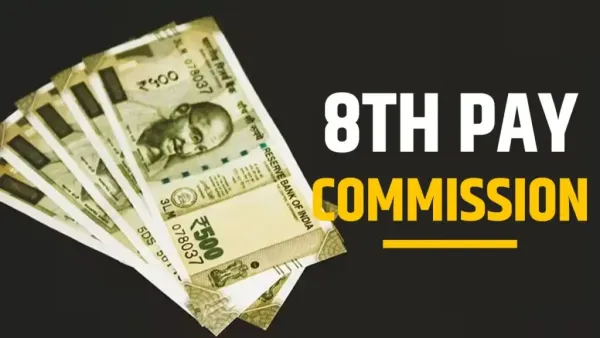
The Eighth Pay Commission has been the biggest talking point for lakhs of central government employees and pensioners for the last few weeks. The round of questions started after the release of its terms and conditions (Terms of Reference) on 3 November 2025. Now this issue is echoing in Parliament also, where the government confirmed the formation of the commission, but rejected the demand of merging Dearness Allowance (DA) with the basic salary.
On December 1, 2025, Lok Sabha MP Anand Bhadauria asked whether the Eighth Pay Commission has been formally formed and whether there is any plan to add DA to the basic pay amid rising inflation. Minister of State for Finance Pankaj Chaudhary clearly said that yes, the commission has been formed through gazette notification on 3 November.
The command of this three-member commission is in the hands of Justice Ranjan Prakash Desai, while Prof. Pulak Ghosh is the part-time member and Pankaj Jain is the member-secretary. But on merging DA or DR (dearness relief) with the basic salary, the minister said – no such proposal is under consideration. That is, the old system will continue, where DA will continue to increase every six months on the basis of All India Consumer Price Index (AICPI-IW).
Pay Commission comes every 10 years, which not only increases the salary but also improves the structure of allowances and pension. In the Seventh Pay Commission (2016), the minimum salary was Rs 18,000 and the fitment factor was 2.57 times. Now the employees were hoping that in view of the inflationary pressure in the Eighth Commission, DA would be merged, which would have given a permanent increase in the salary.
But there is no mention of pensioners in the Terms of Reference – whereas this was clear in the Seventh Commission. Union leaders say that this will limit the scope of pension reform. Also, the minimum wage formula, the problem of pay compression and the demands of the staff side were also not included.
The Commission has got 18 months time. This includes collecting data, talking to departments and taking suggestions from unions. But the biggest question is – when will the new salary structure be implemented? From or after January 1, 2026? The government has maintained silence on this.
Experts believe that if DA was merged, the employees would have got a permanent increase of 20-25% immediately, which would have affected the pension also. But the government argues that the existing DA system is flexible and keeps adjusting automatically with inflation. Currently DA is close to 55%, which may increase further in January 2026.
About 50 lakh central employees and 65 lakh pensioners will be affected by this commission. Prices of food, fuel and rent have increased rapidly in the last two years. If the Eighth Commission brings strong recommendations, not only will salaries increase, but there will also be an additional burden of Rs 1-1.5 lakh crore on the government exchequer.
Unions are now preparing for protests. He says that if the terms of reference are not improved then the movement will intensify. On the other hand, the government says that the commission is independent and will listen to the opinions of all parties.
The new salary structure is likely to be implemented in 2026. Till then DA will continue to increase, but there will be no change in the basic salary. Employees are advised to send suggestions through their union. If you are a government employee, keep an eye on the AICPI index – this will decide how much DA will increase in January.