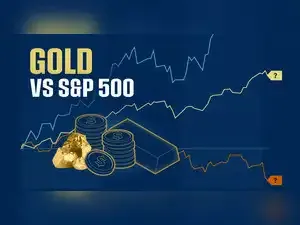
Gold price forecast: Gold’s 30-year surge just beat the S&P 500: Gold has delivered a rare long-term victory. New 30-year market data shows gold outperforming the S&P 500 for the first time in decades. The move is catching the attention of investors who spent years calling the metal a slow performer. But the latest chart tells a different story. Gold is up 953.78% since the mid-1990s. The S&P 500 is up 918.15% over the same period. The gap is small, yet symbolically powerful.
Gold’s surge did not happen in a straight line. The early 2000s gave gold a major lift as the dot-com crash wiped out stock valuations. Then came the 2008 financial crisis, where gold again outperformed as investors rushed toward safety. By 2011, gold had surged above $1,900, putting it far ahead of equities.
The S&P 500 later regained momentum. The long bull market from 2013 to 2021 nearly erased gold’s advantage. Stocks soared on cheap money, corporate earnings growth, and the tech boom. But gold never lost ground. It continued to move upward during every inflation spike and every geopolitical shock.
The final push came between 2020 and 2025. The pandemic-era stimulus wave, inflation running its hottest in four decades, and global political risk drove heavy demand for gold. Prices climbed past $4,000 an ounce in 2025, marking a powerful new peak.
Meanwhile, the S&P 500’s gains slowed. Stocks fell into multiple corrections between 2022 and 2024 as interest rates jumped. While equities recovered, gold’s rise was faster and more consistent. By late 2025, the chart clearly shows gold breaking ahead of the index.
Gold outperforming the S&P 500 over a full 30-year window is unusual. Historically, stocks beat almost every major asset class when dividends are included. But this comparison uses pure price returns. Even so, gold’s ability to nearly match and now exceed stock market performance is notable.
The data reflects the global shift toward safe-haven assets. Investors are hedging against inflation, currency pressure, and geopolitical tensions. The Federal Reserve’s expected policy easing in 2025 is adding momentum to metals. Gold continues to draw steady demand from both retail buyers and central banks.
Gold prices are forecasted to experience a short-term bearish correction toward $3,965 support in early December 2025, followed by a rebound potentially exceeding $5,115 if key levels hold. Monthly outlooks suggest range-bound trading near $4,000, with critical support at $3,900 and resistance at $4,200–$4,400, influenced by ongoing central bank demand and monetary policy. Longer-term, some experts eye prices surpassing $5,000 by 2026 amid economic uncertainty and dollar weakness.
The S&P 500, currently at 6,812.63, is projected to reach 7,500 by end-2026, implying about 10% gains from here, driven by AI-driven earnings growth (13-15%) and expected Fed rate cuts. Analysts anticipate robust U.S. economic leadership and stable policy post-cuts, though aggressive easing could push it above 8,000. Year-to-date, gold has outperformed the index significantly in 2025.
Key Influences:
Gold: Bearish RSI signals and channel tests may cap near-term upside, but breakouts above $4,325 confirm bullish continuation.
S&P 500: High valuations reflect AI capex and fiscal support, with median strategist targets near 7,490 for 2026.
Forecasts carry uncertainty from Fed actions, geopolitics, and data like recent strong U.S. manufacturing PMI.
Gold’s surge did not happen in a straight line. The early 2000s gave gold a major lift as the dot-com crash wiped out stock valuations. Then came the 2008 financial crisis, where gold again outperformed as investors rushed toward safety. By 2011, gold had surged above $1,900, putting it far ahead of equities.
The S&P 500 later regained momentum. The long bull market from 2013 to 2021 nearly erased gold’s advantage. Stocks soared on cheap money, corporate earnings growth, and the tech boom. But gold never lost ground. It continued to move upward during every inflation spike and every geopolitical shock.
The final push came between 2020 and 2025. The pandemic-era stimulus wave, inflation running its hottest in four decades, and global political risk drove heavy demand for gold. Prices climbed past $4,000 an ounce in 2025, marking a powerful new peak.
Meanwhile, the S&P 500’s gains slowed. Stocks fell into multiple corrections between 2022 and 2024 as interest rates jumped. While equities recovered, gold’s rise was faster and more consistent. By late 2025, the chart clearly shows gold breaking ahead of the index.
Gold outperforming the S&P 500 over a full 30-year window is unusual. Historically, stocks beat almost every major asset class when dividends are included. But this comparison uses pure price returns. Even so, gold’s ability to nearly match and now exceed stock market performance is notable.
The data reflects the global shift toward safe-haven assets. Investors are hedging against inflation, currency pressure, and geopolitical tensions. The Federal Reserve’s expected policy easing in 2025 is adding momentum to metals. Gold continues to draw steady demand from both retail buyers and central banks.
Gold prices are forecasted to experience a short-term bearish correction toward $3,965 support in early December 2025, followed by a rebound potentially exceeding $5,115 if key levels hold. Monthly outlooks suggest range-bound trading near $4,000, with critical support at $3,900 and resistance at $4,200–$4,400, influenced by ongoing central bank demand and monetary policy. Longer-term, some experts eye prices surpassing $5,000 by 2026 amid economic uncertainty and dollar weakness.
The S&P 500, currently at 6,812.63, is projected to reach 7,500 by end-2026, implying about 10% gains from here, driven by AI-driven earnings growth (13-15%) and expected Fed rate cuts. Analysts anticipate robust U.S. economic leadership and stable policy post-cuts, though aggressive easing could push it above 8,000. Year-to-date, gold has outperformed the index significantly in 2025.
Key Influences:
Gold: Bearish RSI signals and channel tests may cap near-term upside, but breakouts above $4,325 confirm bullish continuation.
S&P 500: High valuations reflect AI capex and fiscal support, with median strategist targets near 7,490 for 2026.
Forecasts carry uncertainty from Fed actions, geopolitics, and data like recent strong U.S. manufacturing PMI.