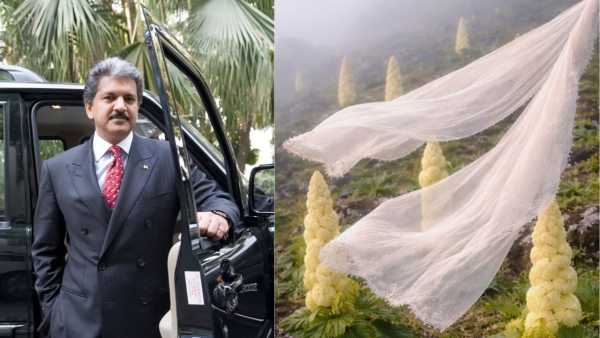
Nature often hides such secrets within itself, which man suddenly encounters and leaves him astonished. One such flower is in discussion among people these days. We are talking about Sikkim Sundari, it is said that it is not a flower, but a symbol of time, patience and wonderful plan of nature. Its life cycle and structure are so extraordinary that even today everyone, from scientists to common people, remains astonished to see it. Interestingly, the country's well-known industrialist Anand Mahindra also stopped to know about it and himself admitted that he had never read about this plant during his school days.
Sikkim Sundari is not just a flower, but a symbol of time, patience and wonderful planning of nature. This plant may appear calm and simple in appearance, but behind it lies a long story of struggle and tolerance. Surviving without any noise for decades and then blooming once again with full force, makes it completely different from other plants.
Anand Mahindra, while sharing pictures and information of this plant on social media platform X, described it as the best example of patience. In scientific language it is called Rheum nobile. This plant is found in the very high altitude areas of the Eastern Himalayas, where it is difficult to imagine a normal life. At an altitude of about 4,000 to 4,800 meters above sea level, this plant maintains its roots amidst cold winds, snow and bright sunlight. Sikkim, eastern Nepal and south-eastern Tibet are considered its main areas.
The most unique thing about this plant is its long and patient life cycle. Sikkim Sundari survives for about 25 to 30 years in the form of small clusters of leaves underground or near the surface. During this period it continues to tolerate harsh cold, strong winds and dangerous ultraviolet rays. Surviving for so long without blooming is a miracle in itself. After this, when the time is ripe, the plant flowers only once and then its life cycle ends.
Its structure is as special as its lifestyle. Sikkim Sundari is called the glasshouse plant, and there is a good reason behind it. There are light brown transparent layers around the plant, which are called bracts. The edges of these bracts are pale pink and the entire structure resembles a cone or temple pagoda. These layers work like a glass house.
The specialty of these transparent bracts is that they allow sunlight to pass inside, due to which the plant remains warm. On the other hand, they protect the flowers and seeds from cold winds and strong UV rays. Because of this, a micro environment is created inside the plant, which is very important for its growth and survival. In the harsh conditions of the Himalayas, this natural protective shield is no less than a boon.
When Sikkim Sundari is fully grown and in bloom, its height can reach about two meters. This plant is visible from a distance amidst the snow covered valleys and rocky slopes. Its light bright color and unique texture creates a distinct identity among the white snow. It seems as if nature itself has specially decorated it to attract attention.
This plant not only gives us the beauty of nature but also gives us a deep lesson. Sikkim Sundari reminds that not everything bears fruit immediately. Some things require time, patience and tolerance. Surviving quietly for decades and blossoming once in full glory is a strong message for today's fast-paced world.
I knew nothing about this extraordinary marvel: the Sikkim Sundari
Thriving at staggering altitudes of 4,0004,800 meters, this “Glasshouse Plant” stands like a glowing tower against the mountains.
Its life is a masterclass in patience.
It is monocarpic, which means that pic.twitter.com/keoMSmGcUl
— anand mahindra (@anandmahindra) December 21, 2025