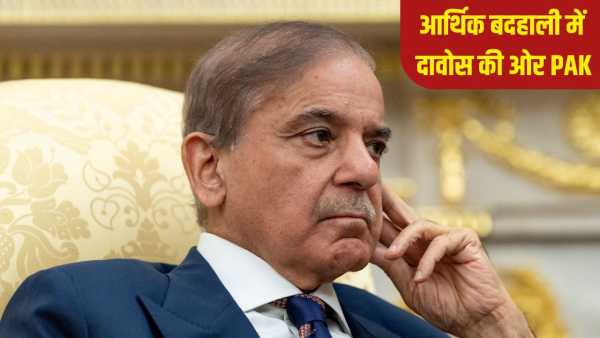
How delicate Pakistan's economic condition is can be gauged from the fact that it is no longer considering a platform like the World Economic Forum as a global economic discussion, but as a platform for garnering investment and seeking trust. Before the World Economic Forum Annual Meeting to be held in Davos in January 2026, Pakistan's Deputy Prime Minister and Foreign Minister Mohammad Ishaq Dar held a high-level meeting and reviewed the preparations. Foreign debt, strict IMF conditions, declining industry and political instability. Amidst all this, Pakistan is once again trying to garner investment and trust on international platforms.
Pakistan The instructions in this meeting were clear. Maximum meetings should be scheduled with heads of state, heads of government and top officials of global financial institutions coming to Davos and ways of cooperation with private sector companies should be explored. The message of this exercise is clear that Pakistan is seeing the World Economic Forum more as a bowl to garner investment than a platform for policy dialogue.
In the last few years, Pakistan's economy has repeatedly reached the brink of default. Without the IMF package, it has been difficult to manage government expenditure, foreign exchange reserves have been under constant pressure and inflation has broken the back of the common citizen. In such a situation, going to a forum like Davos has become a compulsion for Pakistan, not an option.
That is why the meeting emphasized on increasing contacts with global private sector players – as traditional aid and loans are now becoming limited. In the name of investment, Pakistan has neither a stable policy, nor political continuity, nor confidence in security to show. In such a situation, many analysts consider the talks in Davos to be nothing more than a begging for investment.
Another point particularly emerged in the meeting – extensive media engagements. This is not just a coincidence. Pakistan has been facing an image crisis on international forums for a long time—be it questions about terrorism, the weakness of democratic institutions or instability in economic policies.
Media interviews and panel discussions at a high-profile forum like Davos are an opportunity for damage control and image improvement for Pakistan. Trust is needed before investing—and to build trust the story has to change. This is the reason why this time Davos is being seen not only as meetings but also as a PR drive.
This is where the paths of India and Pakistan clearly differ. While India goes to Davos with its economic strength, market potential and long-term vision, Pakistan arrives there looking for credibility and economic support. On one side, a growth story full of confidence, on the other side, crisis management and struggle to save image.
Davos 2026 does not seem to be a new beginning for Pakistan, but a new platform for old compulsions. The question is not whether Pakistan will go to Davos or not. The question is whether he will return with an empty bowl this time, or whether he will be able to convince the world that he has a solid economic roadmap beyond begging.