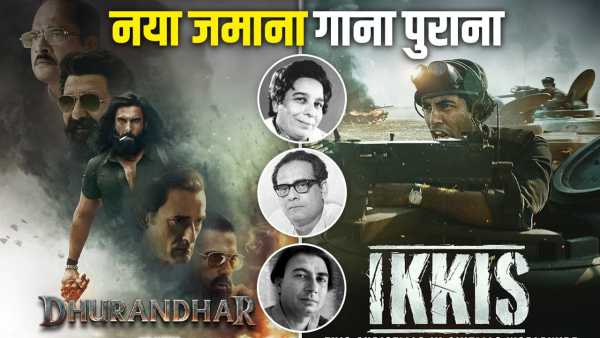
They say The past never comes again… But these days it seems that some new filmmakers are also busy in awakening nostalgia on the silver screen. The bygone era may or may not have come but they are definitely busy in creating the atmosphere. Even if the story is about crime or terrorism and patriotism But on the screen, a lot of sweet sounds of the bygone era are being heard, after listening to which, a pang of joy rises in the corner of anyone's heart. Mukhdas and antaras of old songs are now being used indiscriminately in new films. These songs may not be very suitable according to the story, character and sequence, but many directors of today are using the songs of Shakeel Badayuni, Sahir Ludhianvi or Rajendra Krishna in their films. Why so? We will try to understand this also.
In this connection, it is necessary to mention the two most recent films - twenty one and dashingThe story of Dharmendra, Jaideep Ahlawat and Agastya Nanda's film Ikkis has awakened tender emotions in the minds of the audience, Although it is a war movie, it has a message of peace and brotherhood, Director Shriram Raghavan named Martyr Paramveer Chakra winner Brig, Arun Khetrapal and his father Brig, An attempt has been made to show a different face of the India-Pakistan war by showing the story of (Retd,) Madan Khetrapal,
The story of Ikkis revolves between 1971 and 2001 and during this time, Dev Anand's face, Rajendra Krishna's songs, the heart-touching voices of Uma Devi (Tuntun), Shamshad Begum and Hemant Kumar are also heard well. In one scene of the initial part of the film, when Dharmendra is going to Pakistan in connection with the re-union, in the other scene, Agastya Nanda crosses the border riding on a tank and chasing the Pak Army soldiers, then in the background, the song from the 1947 film Dard in the voice of Uma Devi is played in the background. I am writing the story of a heartless and desperate person, of waiting for you with eyes full of color… is heard. It is pleasant to hear the echo of this song during Dharmendra's visit to Sargodha for the re-union. This song was written by Shakeel Badayuni and the composer was Naushad.
But in some other sequences, the use of old songs, if not very strange, does not seem very appropriate either. For example, when the ISI team is chasing the car of Dharmendra and Jaideep Ahlawat, the ISI staff is engaged in some scuffle, then Hemant Kumar's song is heard in the background… Lost moonlight on the branches of trees… Where is this moonlight again this night, listen to the story of the heart… This was a song from the 1952 film Jaal, starring Dev Anand and Geeta Bali. SD Burman gave the music on the song written by Sahir Ludhianvi. I don't understand the use of this song in this scene.
The sequence of old songs in Ikkis does not stop here… Madan Khetrapal i.e. Dharmendra has gone to the mansion in Sargodha, where his character had spent his childhood before partition. Look at the map and doors and walls of the old house and become emotional. The whole house has gathered to welcome him. His old friends are sitting there, the role which Asrani had played. (This is the last film of Dharmendra and Asrani. Tributes were paid to both of them in the beginning) During the conversation between the two, a song is heard in the background- Spring came in the form of moonlight, oh beauty… The interesting thing is that this song has also been written by Shakeel Badayuni, and the music has been given by Naushad. This was a 1949 film starring Geeta Bali, the name was - Dulari.
Now before twenty-one, watch Aditya Dhar's Dhurandhar. The blockbuster film Dhurandhar starring Ranveer Singh, Sanjay Dutt, Akshay Khanna, R Madhavan, Arjun Rampal etc. is also based on the backdrop of India-Pakistan. In this, Pakistan sponsored terrorism against India has been made the main topic. After the Kandahar plane hijacking and the attack on Parliament, Ajay Sanyal (R Madhavan), who became the head of the Indian intelligence agency IB, runs Operation Dhurandhar and sends Hamza Ali (Ranveer Singh) as an undercover agent to Karachi and Lyari in Pakistan. Hamza Ali gradually becomes engrossed in his mission… and during this, some popular songs are heard in the background in a very absurd manner…
When Hamza Ali is going inside Pakistan through Balochistan, then Neither looking for a caravan… nor looking for a companion… Like, first the Mukhda of the famous Qawwali is heard and then the entire song is heard in a new style. However, here the sweetness of that Qawwali, which was seen during Bharat Bhushan's acting in the film, is missing. It is noteworthy that this Qawwali has been taken from the 1960 film Barsaat Ki Raat. This was also written by Sahir Ludhianvi, and music was given by Roshan. This Qawwali is equally popular even today.
Apart from this, remember that scene of the film - when Hamla Ali targets the people of Babu Dacoit's gang during the party… then Usha Uthup's popular disco song of the eighties… Rambha ho ho ho is also heard…this song continues for a long time and the echo of bullets continues. It is difficult to understand why such a classic disco song was used at such a dangerous crime scene. Hamza Ali has gone to Pakistan after the attack on Parliament but why is a disco song from the eighties playing in this scene… Similarly, a famous song of Pakistani popular singer Hasan Jahangir has also been used in the same film… For example Hawa Hawa O Hawa Oh Hawa, blow away the hair… This song is also from the eighties.
In fact it has become a new fashion. Be it new movies or web series, fragments of old classic songs have started being used. Remember Salman Khan and Rashmika Mandanna's film Sikandar. Although this film could not be successful at the box office, Rashmika had also sung an old tune in front of Salman in it. That song was- Hug me again, that laughter may or may not be night... May be we may meet in some birth or not… Before this also remember Shahrukh Khan's film Jawan. A fragment of the song from Raj Kapoor's film Shri 420 was heard in Jawan… Ramaiya Vasta Vaiya…Ramaiya Vasta Vaiya…I have given my heart to you…
There is no doubt that the songs of today's films are no longer the same as those composed in the past. Even today, old songs add sweetness to the ears and create an atmosphere. In today's films, only they can clearly explain why the directors are using old songs in any story or sequence, but there is no doubt that the strategy of the directors is only that the use of classic songs may bring some different depth to their film and the audience of the new and old generation will go crazy. However, it is being seen that films like Jawan, Dhurandhar or Ikkis are also getting benefit from it. Now it remains to be seen whether the classic songs of the golden era will resonate in Dhurandhar 2 also?