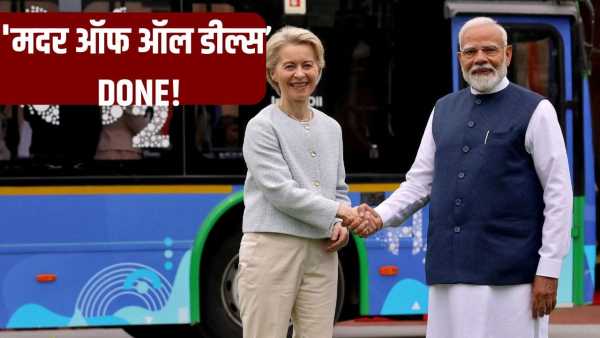
In the environment of global tension, the date of trade deal with India and Europe finally got filed. The deal between the two countries is ready to be signed on the second day of Republic Day i.e. 27th January, which is being called Mother of All Deals. This deal is happening at a time when the Indian market is continuously going down. The global economy seems to be in shock due to America's plan to invade Greenland. Even the American market itself is not able to understand this. Not only this, the relationship between India and the US seems to be weakening. At such a time, negotiating a trade deal with a group of countries like Europe is being considered very important for India's defense sector and all other major sectors. Let us understand in detail who is going to get what from this deal?
India-EU talks first started in 2007. The agreement on which both of them started talking at that time was earlier called Broad-Based Trade and Investment Agreement (BTIA). Several rounds of talks took place between 2007 and 2013, but no consensus could be reached on issues like market access, taxes, intellectual rights, labor rules, environmental standards. For this reason the conversation stopped midway. This was followed by a gap of a few years and then with new political will in 2022, talks resumed to conclude a Comprehensive Free Trade Agreement (FTA).
In February 2025, India and the EU decided to accelerate negotiations on this proposed free trade agreement. Initially the target was to complete the agreement by the end of the year, so that the problems arising from unstable global trade policies could be dealt with. In the financial year 2024-25, India's total exports to the European Union stood at $ 75.85 billion, while imports from there reached $ 60.68 billion. With this, the European Union became the largest trading partner of goods for India.
The India-EU Free Trade Agreement is expected to benefit those sectors which generate more employment and have higher value. Industries like textiles, readymade garments, leather goods and marine products currently attract 2 to 12 percent tax in the European Union. If this tax is reduced or abolished, then Indian products will be cheaper and will be sold more.
Knowledge-based and expensive sectors like pharmaceuticals and chemicals will benefit from easier approval processes and uniform standards. This will make it easier for generic medicines, specialty medicines and chemical products to access the European market. Under this deal, India is also expected to get exemption from the European Union's Carbon Border Adjustment Mechanism (CBAM). However, this issue has not been completely resolved yet and talks are ongoing. The European Union implemented CBAM on 1 October 2023. Under this, 20 to 35 percent tax will be imposed on some imported goods from January 1, 2026. Its objective is to bring carbon emissions close to zero by 2050.
For the European Union, this agreement will open up huge opportunities in India, one of the fastest growing markets in the world. Lower taxes and easier certification are expected on wines, spirits and other alcoholic products coming from Europe, which may make them cheaper for Indian consumers. European car companies, especially those making premium and luxury vehicles, will be able to easily enter the Indian market. This can boost the export of cars, because currently there is a very high import duty on these in India.
Currently, European wines and spirits are taxed at 150 to 200 percent, while luxury cars have import duty at 100 to 125 percent. Apart from this, European companies manufacturing industrial machines, electrical goods and chemicals can also benefit because the barriers related to taxes and regulations will be reduced. Service sectors like IT, engineering, business services and telecom and sectors related to intellectual property will also be able to benefit from clean and stable trade rules. Along with this, new opportunities can also be created in India for special products like aircraft parts, diamonds and luxury goods. Not only trade, but this deal is also likely to increase investment from Europe in manufacturing, green energy and digital infrastructure.