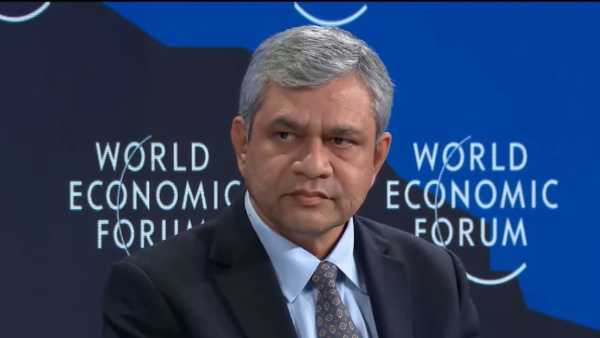
The World Economic Forum (WEF) is being organized in Davos, Switzerland. Union Electronics and Information Technology Minister Ashwini Vaishnav also participated in it. In the discussion titled “AI Power Play, No Referees” at WEF, he told what is India's view regarding AI. He emphasized on the proliferation of AI on a large scale, economic feasibility and techno-legal system.
Minister Ashwini Vaishnav, in response to a question related to Global AI Alliance and Geopolitics, said that India clearly comes in the first group of AI developed countries. There are 5 layers in AI structure. These include application, model, chip, infra and energy. India is continuously working in these 5 areas. India will probably be the largest country providing services to the world at the application level.
The return on investment in AI comes from enterprise-level deployment and increased productivity, he said. Not just by making very large models. He said that about 95 percent of AI use cases can be solved with models in the 20-50 billion parameter range. We already have many of these models and are being deployed in different areas.
Union Minister Ashwini Vaishnav also talked about the role of AI in geopolitics. He cautioned against equating geopolitical power with ownership of very large AI models. The minister said that such models can be discontinued. Even their developers may have to face financial crisis.
Ashwini Vaishnav said, the economy of what I call the 5th Industrial Revolution will have to implement some solutions to get the maximum possible returns – Return on Investment (ROI). The minister emphasized that effective AI deployment is increasingly dependent on CPUs, smaller models and emerging custom silicon. This reduces dependence on any one country. The notion of ownership of AI based only on results is challenged.