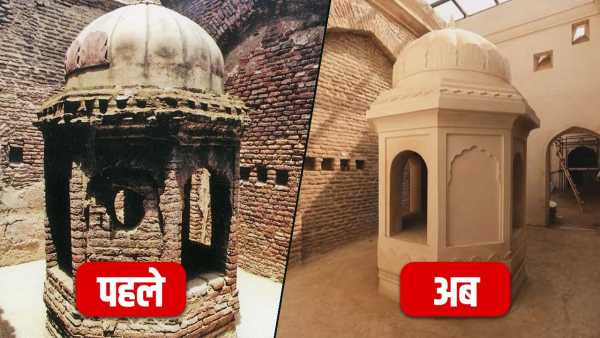
The conservation work of the Loh Temple dedicated to Luv (Loh), son of Lord Ram, located in the Punjab province of Pakistan, has been completed. This temple has been opened for public darshan. Located in the historical Lahore Fort, this temple is considered important from both religious and historical point of view.
Walled City of Lahore Authority (WCLA) said that along with the Loh Mandir, two other historical monuments have also been renovated. These include the Hammam (bathhouse) of the Sikh period and the Athadara Pavilion of Maharaja Ranjit Singh. This entire work has been done with the cooperation of Aga Khan Cultural Service-Pakistan.
This temple located in Lahore Fort is a group of many interconnected rooms. The temple is built under an open sky, where a place of worship is present. It is also called Love or Lava Temple. According to Hindu beliefs, the city of Lahore is also named after Love. Some part of this temple was also restored in the year 2018, but now it has been completely conserved.
WCLA spokesperson Tania Qureshi said that the aim of this project is to bring forward the multi-cultural heritage of Lahore Fort. Lahore Fort contains Sikh and Hindu temples, Mughal era mosques and British era buildings, which reflect its diverse culture. He said that modern and special techniques have been used during conservation.
It is believed that this temple was built during the Sikh Empire. There is no worship here and it has not been preserved like a religious place. BCCI Vice President Rajiv Shukla had gone to Lahore in March 2025, when he Pakistan Had reached here with Home Minister Mohsin Naqvi. He also shared pictures of Loh Mandir.
In the ancient fort of Lahore, there is the ancient mausoleum of Lord Ram's son Luv, the name Lahore is also named after him. Got an opportunity to pray there. Along with Pakistan Home Minister Mohsin Naqvi who is renovating this mausoleum. Mohsin had started this work when he was the Chief Minister. pic.twitter.com/XUhyP0ZC67
— Rajeev Shukla (@ShuklaRajiv) March 6, 2025
According to Hindu beliefs, the ancient name of Lahore was Lavpuri, which was settled by Lav, son of Lord Rama. It is said that when Lord Rama decided to go to Vanaprastha, he handed over the rule to his sons Luv and Kush. During this period, Luv ruled the region of Punjab and made Luvpuri his capital. This Luvpuri later became famous as Lahore. This fact is not mentioned in Valmiki Ramayana, but it is mentioned prominently in folklore and historical documents.
Last year, a Sikh researcher had said that around 100 monuments were maintained in the Lahore Fort during the Sikh rule (1799 to 1849). However, about 30 of these monuments no longer exist.
To make the history of the Sikh period of Lahore Fort accessible to the common people, WCLA has got a guidebook written by Dr. Tarunjit Singh Butalia, a Sikh researcher living in America. Its name is Lahore Fort during the Sikh Empire.
Dr. Butalia said that Lahore Fort is emotionally very special for the Sikh community. It remained the center of power of the Sikh Empire for almost 50 years. He also told that according to the Persian court document Umdat-ut-Tawarikh, his ancestors held important positions in the Sikh court, hence this fort is very important for him personally.