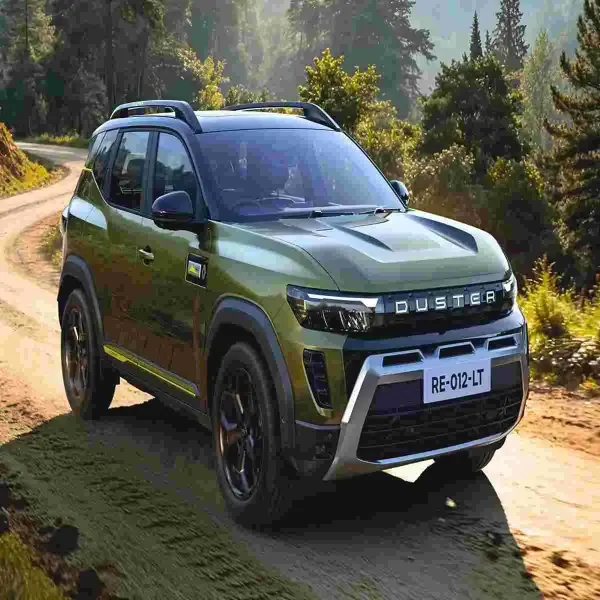
Renault Duster’s 2026: The Renault Duster is set to return to India in 2026, marking one of the most closely watched comebacks in the country’s automotive space. As initial details surface and early interest builds, two issues have sparked the most discussion among buyers and enthusiasts alike: the absence of a diesel engine and uncertainty around the return of an all-wheel-drive version. Renault’s global leadership has now clarified both points, outlining how evolving usage patterns and regulatory realities have shaped the SUV’s new direction.
For much of its earlier life in India, the Duster’s identity was closely tied to its diesel engine. Buyers valued its strong low-end torque, long-distance efficiency, and suitability for varied road conditions. Renault, however, believes that role is now being fulfilled by modern hybrid systems rather than conventional diesel powertrains.
Company executives explain that advances in hybrid technology allow manufacturers to deliver the same everyday benefits once associated with diesel—efficiency, responsiveness, and relaxed cruising—while avoiding challenges linked to emissions and urban restrictions. According to Renault, hybrid powertrains are better aligned with where both regulations and customer expectations are headed.
The upcoming Duster will feature a strong hybrid setup built around a 1.8-litre petrol engine paired with an electric motor and battery pack. Combined output is expected to reach 160bhp. The system is designed to handle most city driving electrically, with Renault claiming that up to 80 per cent of urban usage can be completed in pure electric mode under typical conditions.
Renault’s leadership acknowledges that the new Duster is no longer positioned as a purely rugged, utilitarian SUV. Instead, it is intended to operate comfortably across urban, suburban, and light rural environments. This shift in positioning has played a major role in the decision to move away from diesel engines.
While diesel power still offers strong torque, Renault points out that tightening emission norms and increasing restrictions on diesel vehicles in large cities make them less practical for the future. Urban congestion and short-distance driving cycles also favour electrified solutions, where hybrids can significantly reduce fuel consumption and tailpipe emissions.
Design and product teams believe that once drivers experience the new powertrains in real-world conditions, concerns about the lack of diesel will ease. Renault maintains that the hybrid system delivers smooth performance and immediate response, particularly in stop-and-go traffic.
Another key question surrounding the new Duster is the absence of an all-wheel-drive option. The original model earned a loyal following by offering AWD in a segment where it was rare, giving it a reputation for capability beyond paved roads.
Renault confirms that the underlying platform used for the new Duster is technically capable of supporting multiple drivetrain configurations, including AWD, electric all-wheel drive, and hybrid-based systems. From an engineering standpoint, there are no major limitations.
The deciding factor, according to the company, is market demand. Current data suggests that interest in four-wheel-drive systems within the Indian mid-size SUV segment remains limited. Most buyers prioritise comfort, efficiency, and ease of ownership over off-road capability. As a result, Renault has chosen to focus on front-wheel-drive petrol turbo and hybrid variants that appeal to a wider customer base.
That said, the door has not been permanently closed. Renault indicates that if consumer preferences shift—particularly with the rise of electrification—the platform is ready to support more advanced drivetrain options in the future.
Rather than relying on nostalgia, Renault is positioning the 2026 Duster as a forward-looking product shaped by how SUVs are actually used in modern India. Diesel engines, once central to its appeal, have been replaced by hybrid technology aimed at delivering similar performance with greater urban efficiency.
With prices expected to be announced around March 2026 and deliveries scheduled soon after, the Duster’s return represents a calculated reinvention. Renault is betting that a cleaner, more city-friendly approach will resonate with today’s buyers while leaving room to adapt if market demand evolves.