
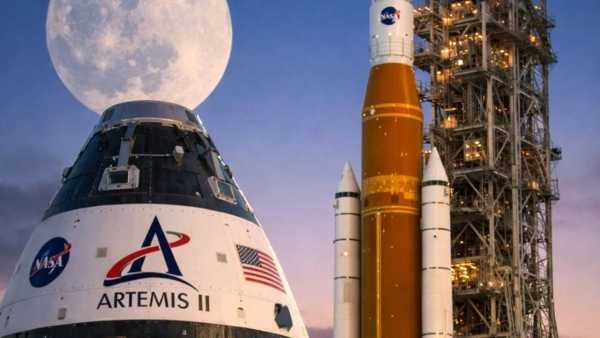
Space agency NASA launched Artemis II mission today (April 2). According to Indian time, this mission was successfully launched using Space Launch System (SLS) rocket at 03:54 am from Kennedy Space Center in Florida. Where thousands of people became witnesses of this historical moment.
Three American and one Canadian astronauts are included in this mission. Commander Reid Wiseman is accompanied by pilots Victor Glover and Canadian Jeremy Hansen as well as Christina Koch. It is the most unique group ever, including the first woman, representation from people of color and a non-American member. Christina Koch is the first female astronaut to go to the moon. This mission reflects a strong example of increasing diversity, equal opportunity and international cooperation in the space sector.
Liftoff.
The Artemis II mission launched from @NASAKennedy at 6:35pm ET (2235 UTC), propelling four astronauts on a journey around the Moon.
Artemis II will pave the way for future Moon landings, as well as the next giant leap — astronauts on Mars. pic.twitter.com/ENQA4RTqAc
— NASA (@NASA) April 1, 2026
Artemis II mission will last for about 10 days. For the first 25 hours, astronauts will remain in Earth's orbit to examine the capsule. After this they will move towards the moon. Although they will not land on the Moon, they will create history by passing by it. Four astronauts will return by orbiting the moon instead of landing on its surface. After 50 years, this journey of humans is not only historical, but also a decisive scientific experiment for future long space journeys.
This mission is the first such mission after the Apollo program in which humans will go to the moon. The purpose of this mission is to investigate new technologies and systems in space. After the launch, all the systems like life support, navigation and communication will be tested by staying in Earth's orbit for the first two days. After this, the spacecraft will move towards the Moon and while passing by it will conduct necessary tests, so that the technical improvements and safety measures necessary for future long space missions can be further improved.
These astronauts will go about 6,400 km beyond the Moon and then return back to Earth. During this time they may become the farthest people in human history. During the journey, the astronauts will see the Moon the size of a basketball. They will take pictures of it and possibly see scenes that humans have never seen before. Additionally, they will also experience a partial solar eclipse. This mission will test many new systems of the Orion capsule, including facilities like life support, water and toilet. However, the risk in the mission is also not less, because problems like hydrogen leak have already surfaced in the rocket.
The Artemis II mission is part of NASA's long-term plan to build a permanent base on the Moon. Many more missions will be launched in the coming years, which will also include robotic rovers and drones. According to experts, this mission is not just a space journey, but a new chapter in human history. This is their Apollo for the generations who did not see the earlier lunar missions.
Astronauts believe that the Moon will pave the way to reach Mars in the future. This mission will prove that humans can live and work for long periods of time in deep space.