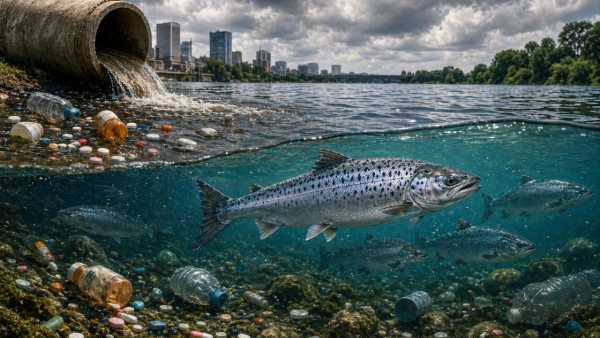
Drug addiction in humans is not a new problem, but now its impact seems to be extending beyond human society to aquatic animals. Recently, a study conducted by Swedish scientists has revealed shocking facts in this direction. Research has shown that drug residues reaching rivers and lakes are now affecting fish, especially salmon species. This situation is being considered a serious warning for the environment.
This study was started by environmental scientist Jack Brand in the year 2022. Their objective was to understand how drugs and drug compounds used by humans, when dissolved in water, affect the behavior and life cycle of aquatic animals. In this direction, he conducted a controlled experiment, which focused on salmon fishes in a lake in Sweden. During the research, scientists implanted small capsules in the bodies of some fishes. These capsules slowly released very small amounts of cocaine and its by-product benzoylecgonine.
This quantity was exactly the same as is usually found in polluted water sources. In this way, scientists wanted to simulate real conditions, so that it could be understood to what extent these chemicals present in natural water affect the fish. The results of the study were quite surprising. The behavior of the fishes which were kept in contact with these substances appeared completely different from that of normal fishes. She started swimming faster and covering greater distances than expected. This indicated that these chemicals were having a direct effect on their body and mind.
The most interesting thing that came to light was that its residue benzoylecgonine was showing more effect than cocaine. The fishes which were affected by this became even more active. His behavior seemed as if he was in a constant state of excitement or high. This abnormal activity can prove harmful for them in the long run. Scientists believe that such changes are not limited to the behavior of fish only, but can affect the entire ecosystem. For example, when fish become excessively active, their energy runs out quickly. This can weaken them and become easy targets for hunters. In this way imbalance can arise in the food chain.
Apart from this, not only drugs but also traces of many types of drugs are being found in water sources around the world. These include anti-anxiety medicines, painkillers and other pharmaceutical products. All these substances can affect the behavior, reproductive capacity and life span of aquatic organisms. In the long run this situation can become a threat to biodiversity. Experts say that it is not easy to completely purify waste water. Large quantities of water are treated every day, but completely removing these trace chemicals is technically complex and expensive. Existing purification systems are not able to completely eliminate these substances, causing them to gradually accumulate in water sources.