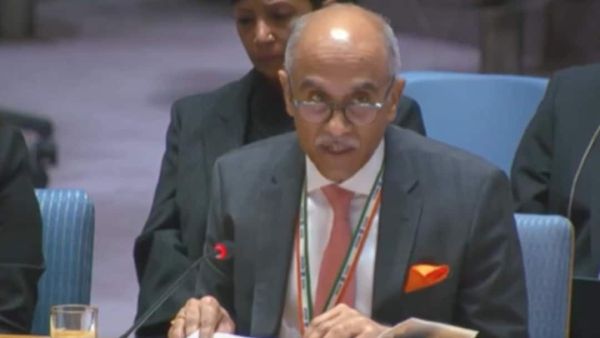
India on Monday strongly criticised Pakistan at the United Nations, accusing Islamabad of promoting an anti-India narrative through its use of the term "Fitna al-Hindustan" and describing the campaign as an example of state-sponsored misinformation aimed at fuelling hostility among its citizens.
Speaking at a United Nations Security Council meeting on the situation in Afghanistan, India's Permanent Representative to the UN, Harish Parvathaneni, said Pakistan's decision to direct government agencies to refer to groups operating within its borders as "Fitna al-Hindustan" reflected a deliberate effort to spread disinformation.
Parvathaneni said Pakistan's official notifications instructing state institutions to use the term amounted to "officially sponsored misinformation and disinformation dressed in religious terminology."
Pakistan last year designated terrorist groups operating in Balochistan as "Fitna al-Hindustan," alleging that they were acting at India's behest. Islamabad has not publicly produced evidence to support those claims.
The Indian envoy argued that the terminology was part of a broader strategy by Pakistan's establishment to maintain hostility towards India.
"It is an outcome of an organised factory of hate coming from the deep state of Pakistan which aims to keep their citizens in a state of permanent hostility with India in order to perpetuate their stay in power and control of national resources and detract them from core political and economic problems," he said.
STORY | India at UNSC: Pak's 'Fitna al Hindustan' narrative 'officially sponsored misinformation'
— Press Trust of India (@PTI_News) June 8, 2026
India on Monday hit out at Pakistan at the UN, slamming Islamabad’s decision to refer to groups inside its own borders as 'Fitna al-Hindustan' as nothing but "officially sponsored… pic.twitter.com/EbJmxRMwPi
Parvathaneni also linked the narrative to what he described as the growing influence of Pakistan's military over the country's political system.
Referring to constitutional changes adopted in Pakistan last year, he said, "The de facto coup by the military through the 27th Constitutional Amendment is only its most recent manifestation."
The amendment paved the way for the creation of the post of Chief of Defence Forces, with Field Marshal Asim Munir subsequently appointed as the country's first CDF.
The Indian envoy also criticised Pakistan's military operations in Afghanistan, accusing Islamabad of causing civilian casualties through airstrikes.
"Let me reiterate. Dressing up a massacre as a military operation does not absolve the perpetrator. Killing, maiming and orphaning civilians is not counter terrorism," Parvathaneni said.
He further accused Pakistan of hypocrisy, saying that military strikes carried out during the holy month of Ramadan contradicted its claims of adherence to international law and Islamic solidarity.
Taking aim at Islamabad's repeated accusations against neighbouring countries, Parvathaneni said Pakistan was attempting to shift attention away from its internal challenges.
"Blaming neighbours for its own failures is an old Pakistani habit. This attempt to hoodwink the world will fail," he said.
The remarks marked one of India's sharpest diplomatic attacks on Pakistan at the UN in recent months and came amid continuing tensions between the two countries over regional security issues and cross-border terrorism.