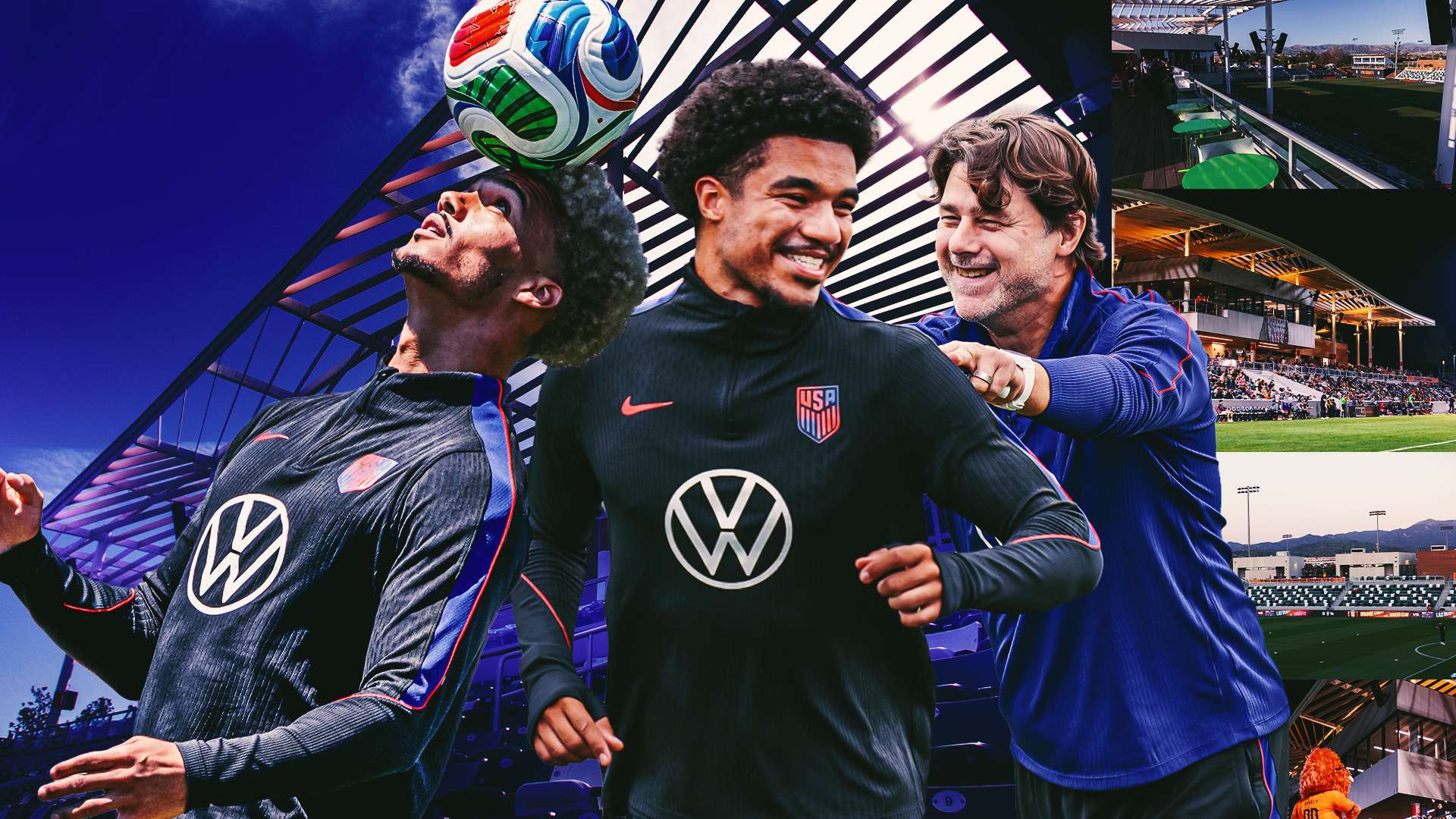
For the next several weeks, the United States Men's National Team will be stationed in Orange County, California, but the journey to make that happen has taken years of planning and coordination.
IRVINE, California — “Wait, you haven’t seen the balloon?”
Sam Zapatka, the team manager for the U.S. Men’s National Team, quickly pulls out his phone, scrolling past photos of his newborn baby before showing an image of a hot-air balloon emblazoned with a large U.S. Soccer logo. This balloon will soar above Great Park in Irvine, California, this summer — a fitting symbol for the city that will serve as the USMNT’s base during the opening stages of the 2026 World Cup.
Throughout the group stage, the American squad will live and train in Orange County, making it their temporary home during one of the most monumental periods in the nation’s football history. The team will commute to SoFi Stadium for their first and third matches against Paraguay and Turkey, respectively, with a brief trip to Seattle for their second fixture.
While the setup seems straightforward, the process behind bringing Team USA to Irvine was anything but simple. It took years of preparation and collaboration — a process that inspired local pride, displaced a football club, and tied into the rich history of a region once home to U.S. presidents and military heroes. This summer, America’s football stars have arrived in Orange County, ready to create a new chapter of memories.
On Monday, approximately 5,500 residents filled Great Park to catch their first glimpse of the national team. Another 33,000 tried to get tickets but couldn’t. This marked the beginning of the USMNT’s World Cup campaign and the culmination of a six-year project set to transform not just a city, but possibly the entire country’s football culture.
Local history
If anyone can explain the essence of Irvine, it’s Mayor Larry Agran, currently serving his sixth non-consecutive term as the city’s leader. As American football arrived in his city, he offered a lesson on the very ground where it all was happening.
Great Park — home to the Championship Soccer Stadium where the U.S. team is training — is still a work in progress, less than two decades old. Before that, the land served as Marine Corps Air Station El Toro for 56 years. Every U.S. president since World War II has landed there on Air Force One, and countless servicemen and women once lived, trained, and departed from that base for wars overseas.
“Pilots who fought in the Pacific during World War II were trained here,” Agran said on Monday. “For many, this was their last stop on U.S. soil before heading into battle — not only in World War II but also in Korea and Vietnam. It remained a military training base until the 1990s.
“There’s so much history here — many men and women passed through this land. At Great Park, we try to honour that legacy and preserve the sacred nature of this place.”
One way to do that, Agran said, is to make Great Park a true destination — and what better time than during a World Cup? While Irvine is too small to host a match, it could still play a vital role by serving as a World Cup base camp.
Six years ago, the city officially submitted its interest. In the years that followed, FIFA conducted multiple inspections to ensure the facilities met international standards. Irvine passed every test, and over a three-year period, numerous teams visited to evaluate the site.
The hosting effort was a partnership between the city and the local club, Orange County SC (OCSC), the resident team at Championship Soccer Stadium.
Becoming hosts
Dan Rutstein, president of OCSC, was instrumental from the start, though he admits the outcome was uncertain. Irvine wanted to host a team — but which one remained a mystery.
“I’m not going to name names,” Rutstein told GOAL, “but two teams that visited never made it to the World Cup. Their logistics teams came here to plan in case they qualified, but sadly, they didn’t. We were hoping for a top-tier team because, no disrespect, but if Curaçao had used this base, it wouldn’t have had the same impact.”
Among the visitors were representatives from U.S. Soccer. Rutstein estimates they visited at least six times, examining every detail — camera placements, ice baths, massage tables, kit-washing facilities, and even jurisdictional questions like which police force would escort the team if hotels and stadiums were in different areas.
“Someone could write a whole book about how to prepare for a tournament,” Rutstein said. “There are countless details that ensure players feel at home. We only see about 10 percent of it, but the behind-the-scenes logistics are incredible.”
OCSC and the city provided answers to every question, and in March, U.S. Soccer officially announced that Orange County would serve as the team’s World Cup base.
“We’ve had all sorts of world-class teams visit,” Rutstein said, “but when we finally heard it was the U.S. team, it was massive. It doesn’t get bigger than that.”
The facilities, just under 15 years old, are anchored by the iconic hot-air balloon. Beyond that, the venue offers numerous amenities and plenty of space. Its location is ideal — about 45 miles from SoFi Stadium. On a good day, the commute takes an hour, keeping the players close enough to Los Angeles for convenience but far enough for peace and focus.
“When we learned we’d be based on the West Coast, we toured 27 facilities from Seattle down to San Diego,” Zapatka said. “But once we arrived in Orange County, it instantly felt like home. People here welcomed us with open arms — they literally said, ‘Welcome home.’ We chose this place for its people and its quality.”
Rutstein praises the facilities but also highlights their charm. “There are football fields everywhere, but this one has a special beauty,” he said. “The mountains in the background, the sunset, and that balloon — it’s one of the most stunning stadiums I’ve ever seen. And the weather? Perfect. It’s sunny and 75 degrees almost all year. Orange County is blessed.”
But hosting comes with challenges, especially for the local club.
Short-term pain
“Let me be very clear,” Rutstein said. “This isn’t a complaint, but there’s definitely short-term pain for us.”
As OCSC president, Rutstein’s team had to vacate their home ground for the duration of the USMNT’s stay — right in the middle of their USL Championship season. The club sits second in their group, two points off the top with a game in hand.
So what does hosting mean for OCSC? Essentially, staying out of the way.
“We’ve had to move all our merchandise stock elsewhere,” Rutstein said. “It’s been logistically tough because we’re three years into a 10-year lease and literally can’t access the stadium. Areas our players used — like the manager’s office and VIP stands — are now being used by the national team. They’ve completely taken over. We’ve effectively been evicted.”
OCSC will be away from their home ground for six weeks. They’ve spent thousands removing branding to meet FIFA’s strict neutrality rules — no OCSC logos in locker rooms, tunnels, or anywhere else. From the moment Team USA arrived, the stadium became theirs.
Still, Rutstein and his team see opportunity in the disruption. Most matches over the next nine weeks will be away games, but on May 23, they hosted Oakland Roots SC at Santa Ana Stadium, a nearby venue with nearly double the capacity of their usual home.
Rutstein says his club remains ready to assist if needed, as they did when Canada trained there recently. “We even helped them with laundry,” he said. “Once, they needed a left winger for a scrimmage, so we lent them one of our academy players. I doubt the U.S. will need that, but if they do, we’re right next door.”
Long-term gain
OCSC has built a strong reputation for developing talent, having transferred eight players to Europe since 2020. Recent sales include Pedro Guimaraes (Eintracht Frankfurt), Korede Osundina (Feyenoord), Milan Iloski (FC Nordsjaelland), Kobi Henry (Stade de Reims), and Aaron Cervantes (Rangers).
For Rutstein, hosting the national team reinforces the club’s status as a key player in American football development. “We’re focused on nurturing young talent,” he said. “For us, having the present of American soccer training on the same field where the future trains every week is powerful. Our youth internationals can now see a real pathway — maybe not this World Cup, but the next one.”
Financially and reputationally, the benefits are clear. The club is currently seeking stadium naming rights, and the global exposure will only help.
“In the end, people will discover their local football teams,” Rutstein said. “If you can’t afford a $250 parking ticket at SoFi, that same money can get you two season tickets here, plus food, drinks, and shirts for the family.”
He added, “Sure, there’s short-term pain, but the long-term reward is immense. Our stadium and our sport will be on the map forever. Irvine will always be remembered as the U.S. training base during the World Cup, and that’s something permanent.”
Local impact
Agran notes that Irvine’s population is about 330,000 and growing rapidly — expected to surpass 400,000 within a decade. “I don’t want to sound overly sentimental,” he said, “but great things happen when communities come together. Sports can unite people and teach values of teamwork and respect. It’s uplifting for everyone.”
On Monday, that spirit was evident as thousands gathered at Great Park to watch the USMNT train. Young fans queued for autographs, players took selfies, and coach Mauricio Pochettino grabbed the microphone to thank the crowd before leading a “USA” chant.
“This is beyond what we expected — the facilities and the people are both amazing,” Pochettino said. “You can have great facilities but not great people. Here, we have both, and we’re very grateful. Everything has been prepared with love — that’s what matters most.”
Rutstein believes the local community will feel the impact long after the team leaves. “There’ll be police escorts, TV trucks, media crews — it’ll feel like something special is happening,” he said. “You might see Christian Pulisic at a café or run into Joe Max Moore, Bobby Wood, Alexi Lalas, or Landon Donovan around town. Irvine will feel alive.”
For a few weeks, Irvine will be the epicentre of American football. And as that balloon floats above Great Park, it will stand as a symbol of how one community embraced a national dream — and helped propel it skyward.