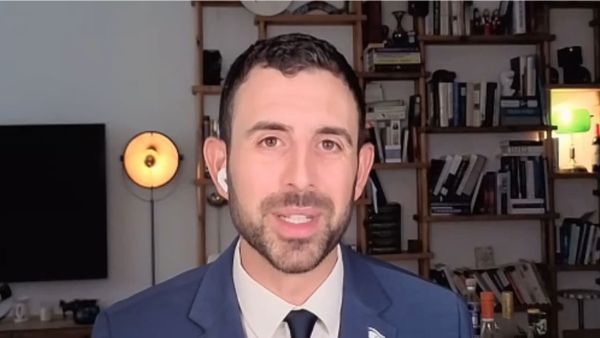
Speaking to ANI, Levy said the 'October 7 massacre' marked a turning point in Israeli security thinking. He said, "Israel's new security doctrine after the October 7th massacre is that we will no longer allow terrorist armies to rebuild their forces right on our border. We will not allow Iranian proxy armies to be literally walking distance from people's houses, the same houses they're attacking with rockets and drones."

The October 7 attacks were a series of coordinated armed incursions from the blockaded Gaza Strip into the Gaza envelope of southern Israel, reported to be carried out by Hamas and several other Palestinian militant groups in 2023, during the Jewish holiday of Simchat Torah.
Levy said Israel is maintaing protective security zones in parts of Lebanon, Syria and Gaza to keep "terrorist armies" away from Israeli communities. He said, "That's why Israel is building a protective perimeter inside Lebanon, Syria, and Gaza to keep those terrorist armies at bay."
Referring to ongoing rounds of peace talks between Israel and Lebanon, Levy suggested that security concerns linked to Hezbollah would remain central to any future arrangements. "There are peace talks between Israel and Lebanon... we can expect to see Israel telling the Lebanese, as long as Hezbollah is using your territory to attack Israeli families, we have a buffer zone to keep them away. But you can have that territory back if you end the threat from Hezbollah," he said.
Levy also expressed concern over the ongoing peace deal between the US and Iran, warning that Israel fears a repeat of previous international agreements that, in its view, failed to eliminate the threat posed by Tehran. "The fear is we'll end up with another deal like the Obama deal that put temporary restrictions on the Iranian nuclear program, pumped it full of billions of dollars that it invested in its ballistic missiles and proxy armies, and left open the pathway to nuclear weapons," he said.
Referring to US President Donald Trump, Levy added, "President Trump was the number one critic of the Obama deal. He's aware of those threats, and I hope that he's not going to fall into the same trap as his predecessor."
"Obama Deal" here refers to the 2015 Iran Nuclear Deal (officially the Joint Comprehensive Plan of Action, or JCPOA). According to the US State Department, "On July 14, 2015, the P5+1 (China, France, Germany, Russia, the United Kingdom, and the United States), the European Union (EU), and Iran reached a Joint Comprehensive Plan of Action (JCPOA) to ensure that Iran's nuclear program will be exclusively peaceful. October 18, 2015, marked Adoption Day of the JCPOA, the date on which the JCPOA came into effect, and participants began taking steps necessary to implement their JCPOA commitments. January 16, 2016, marked the Implementation Day of the JCPOA."
According to Levy, any lasting solution must address what he called Iran's "triple threat" of nuclear ambitions, ballistic missiles and proxy forces. "We're talking about the need to eliminate the triple threat from Iran of the nuclear program, ballistic missiles, and proxy armies. The deal doesn't do any of those at the moment," he said.
Levy argued that the region's instability is rooted in Iran's political system and rejected the notion that trade or diplomatic engagement could moderate Tehran's behaviour. "The problem in the Middle East is never going to be solved as long as Iran is governed by a fundamentalist, fanatical religious regime that swears death to America, death to Israel, and is willing to impoverish its own people and enslave the entire region to pursue its goal of domination," he said.
"The US will have to shift towards proactively supporting the Iranian people who want to build a free country. Any idea that you can moderate Iran through trade or through agreements is a fantasy," Levy added.
Commenting on the current diplomatic process, Levy said Israel remains unconvinced that it adequately addresses Iran's support for armed groups across the region. "The current diplomatic process does not solve any of the problems of the Iranian regime. There's a huge gulf between a piece of paper that says Iran will support regional stability and a verifiable end to its support for proxy armies in the region," he said.
He further alleged that Tehran is seeking to rebuild its regional network of allied armed organisations. "The Iranian regime is trying to rebuild its ring of fire, its network of terrorist armies around Israel," Levy said.
Levy also warned against arrangements that could increase Iranian influence in Lebanon. "Any agreement that links Lebanon to Iran ends up strengthening Iran's stranglehold on Lebanon, making it more difficult for Lebanon to make peace with Israel," he said.
On sanctions relief and the possible release of frozen Iranian assets, Levy said Israel fears the resources could be redirected towards Tehran's regional allies. "Israel is concerned that the Iranian regime will use that sanctions relief to rebuild its terrorist armies in the region, to strengthen its stranglehold on Lebanon, Yemen, which will allow it to continue to threaten ships in the Red Sea," he said.
He reiterated that international efforts should focus on supporting political change within Iran rather than accommodating the current leadership. "The focus now has to be on how to support the Iranian people to achieve their freedom and their democracy and bring down the regime, rather than trying to reach an arrangement with the regime," Levy said.
Levy also acknowledged Israel's differences with Washington over the emerging peace deal with Tehran. "There is no hiding Israel's disagreement with this deal," he said, arguing that the agreement fails to address what Israel considers both its own security concerns and broader American strategic interests.
He added, "PM Netanyahu held a press conference last night in which he recapped all of Israel's achievements in this war without addressing the deal at all. that sent a tacit message that Israel is not happy with this agreement and doesn't think it addresses not only Israel's red lines, but America's red lines as well."
(Except for the headline, this story has not been edited by Asianet Newsable English staff and is published from a syndicated feed.)