Yamuna water agreement between Rajasthan and Haryana was pending for 32 years. At last it has now been sealed. Rajasthan has signed the MOU related to this. This water agreement will quench the thirst of both the states. It can also provide relief from the flood situation that occurs every year during the rainy season in Delhi.
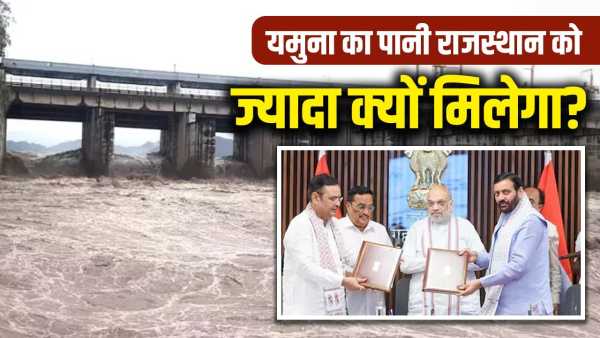
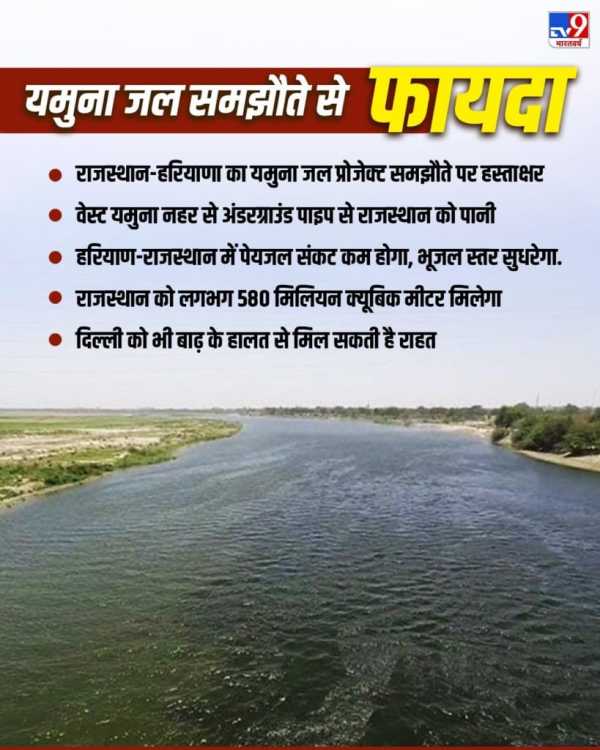
On June 28, in the presence of Union Home Minister and Cooperation Minister Amit Shah, Rajasthan and Haryana Chief Ministers Nayab Singh Saini and Bhajanlal Sharma signed the Yamuna Water Agreement. According to this agreement, Yamuna water will be transported to Rajasthan through underground pipeline from Hathnikund Barrage. With this, the groundwater crisis of Haryana along with Rajasthan will improve.
In the year 1994, an agreement named Yamuna Basin was signed between Haryana, Uttar Pradesh, Himachal Pradesh, Rajasthan and Delhi. In this agreement, the annually available water flow of Yamuna River was to be divided proportionately among all the states. Under the agreement, Haryana was to get 40.6%, Uttar Pradesh 35.1%, Rajasthan 10.4%, Delhi 6.3% and Himachal Pradesh 1.7% Yamuna water.
Even after the Yamuna Basin Agreement, Rajasthan could not get its share of water due to lack of infrastructure and non-availability of any clear and transparent system of water sharing. Due to this, there was a severe drinking water crisis for decades in many areas of Rajasthan as well as in the border areas of Haryana. There was a tussle between the two states regarding this issue for 32 years.
Now, under the MoU of Yamuna Water Agreement, Rajasthan will get 580 million cubic meters (MCM) of water. But this water will be provided by Haryana only between July and October. For this, a 300 km long underground pipeline will be laid, which will start from Hathnikund Barrage in Haryana and will reach Hansiyawas Reservoir in Churu district of Rajasthan. An estimated expenditure of Rs 3900 crore has been estimated on the project. Under the MoU, the responsibility of land acquisition, pipeline construction and monitoring will be of both the state governments.
Construction of three underground pipelines of 3.6 meter diameter under the project. Additionally, inspection roads, artificial reservoirs and a modern water management system will be constructed. The project has been designed in such a way that Haryana can also benefit and both the states do not get trapped in future disputes regarding it. Under this, drinking water will also be made available in those 10 border areas of Haryana where there is severe water crisis.
Many districts of Rajasthan and Haryana will benefit from this water agreement. But Sikar, Churu and Jhunjhunu districts of Rajasthan will get the maximum benefit. There is a drinking water crisis in these areas for a long time. At the same time, the thirst of the people of Bhiwani and Fatehabad districts of Haryana will also be quenched due to this project.
The project will not only get rid of the drinking water crisis, but will also significantly improve the living standards of the people in areas where water availability is less. People will not have to go to distant areas to get water. Water recharge will increase and due to water availability, relief from drought can provide good benefits to farming, which can prove to be very important for local development.