New Delhi . The harmful effects of plastic bottles have once again come to light. A research has revealed that small plastic particles released from single-use plastic bottles can cause serious harm to our health by affecting the vital systems of our body.
The team of Institute of Nano Science and Technology (INST), Mohali, has found in a research that ultra-fine plastic particles made from single-use plastic (PET) bottles can cause serious harm to the beneficial microorganisms and cells of the human body.
Institute of Nano Science and Technology (INST), Mohali is an autonomous institute under the Ministry of Science and Technology (DST). Its team found in a research that micro plastics reach the body and affect the intestinal microorganisms beneficial for the stomach. These microorganisms control our immunity, metabolism and even mental health.
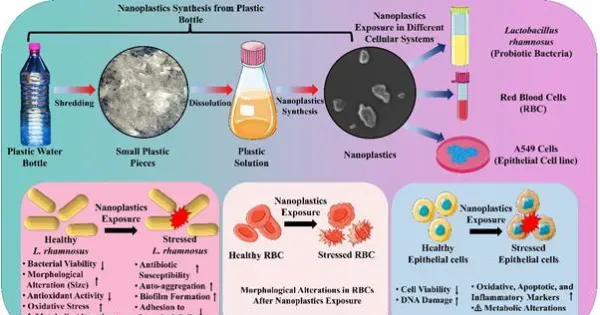
Through research, scientists have understood what happens when these microorganisms come in contact with ultra-fine plastic. He created ultra-fine plastics from PET bottles in the lab and tested them on a beneficial bacteria ‘Lactobacillus rhamnosus’. The researchers found that long-term exposure reduced bacterial growth and protective function, while increasing stress responses and sensitivity to antibiotics.
He told that these micro plastics are causing direct harm to our stomach health and also in excess quantity spoil the membrane of blood cells. Additionally, microplastics are also damaging DNA.
The effect on red blood cells was also examined. Large amounts of nanoplastics damaged cell membranes and caused changes in hematopoiesis. Studies have also been conducted to characterize normal cellular responses. Here, long-term exposure led to DNA damage, oxidative stress, apoptosis and inflammatory signaling as well as changes in energy and nutrient metabolism.
From this research it has become clear that these micro plastics made from everyday used plastic are not just garbage, but they are ‘biologically active particles’.