
Nowadays, people can point at an empty corner of a living room to see a bookshelf or see if a jacket fits them. Even going to the shopping mall. In 2025, augmented reality (AR) shopping apps have quietly become one of the fastest-growing tools in global retail, transforming the online buying experience into something deeply personal, practical, and even fun.
What started as an experimental feature in a handful of apps has now become a mainstream expectation. From fashion and beauty to furniture, cars, and home décor, AR is rewriting the rules of how people discover and evaluate products, and perhaps changing what it means to “shop” at all.
Online shopping has long offered convenience, but it struggled with a straightforward limitation: you couldn’t touch or see the product in your real environment. AR has stepped directly into that gap.
Today’s AR shopping apps do not merely overlay images; they use precise spatial mapping, object occlusion, body scanning, and realistic textures to make products appear anchored in the user’s world.
This evolution addresses the most lingering hesitation among online shoppers: “Will this actually work for me?”
Fashion retailers were among the earliest adopters of AR because the need was obvious. Clothes fit differently on everybody. Shades appear different on every skin tone. Virtual try-on features now allow users to:

The adoption has been robust among Gen Z and Gen Alpha, groups who already see digital identity as an extension of physical identity. For them, AR is intuitive, playful, and empowering.
Retail analysts note that incorporating AR try-ons can reduce return rates by up to 40%, a significant incentive for brands to invest further. In a world increasingly conscious of sustainability, fewer returns also mean fewer carbon emissions from reverse logistics.
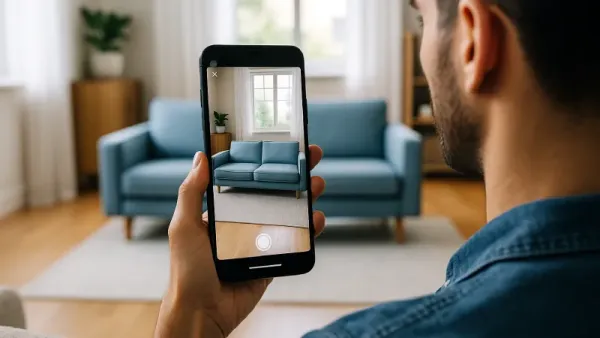
If fashion AR is about personal expression, furniture AR is about confidence. Ask anyone who has bought a sofa online, and they will say it’s stressful.
Do you think it will fit? Will the colour clash with the curtains? Will the room feel too cramped? AR entirely changes that journey. Apps from global and regional retailers now let users:

For homeowners, the shift is liberating. For renters, it solves a long-standing emotional hesitation, the fear of choosing something that doesn’t “belong” in a temporary home.
Interior designers have also embraced AR as a communication tool. Clients who previously struggled to imagine final layouts can now “walk through” their home before buying the first piece.
What makes AR rise compelling is how it blurs the line between online and offline shopping.
Shoppers increasingly use AR to prequalify products before visiting a store or to explore items they don’t want to handle physically, such as mattresses, heavy appliances, or fragile décor pieces.
In-store AR kiosks also allow customers to visualise products in alternative colours or sizes that may not be physically available.
For retailers, AR doesn’t replace physical stores; it enhances them. Hybrid shopping journeys strengthen brand loyalty by making the experience more holistic, more informative, and more personal.

Several human-centred motivations are shaping the global adoption curve of AR shopping apps:
For retailers, AR does more than boost conversions. It provides data, not personal data in a privacy-intrusive sense, but behavioural insights about what customers explore, reject, compare, or visualise the most. Such insights reshape product design, supply chains, and marketing strategies. For example:

Despite rapid adoption, AR is not perfect:
From Seoul to San Francisco, Berlin to Bengaluru, shoppers are approaching purchases with a new digital confidence. Retail is becoming a space where imagination and reality meet, enabling consumers to make informed decisions without guesswork.
AR is also democratizing design and personal style. You no longer need a design background to plan a living room or a high-end stylist to experiment with fashion. The technology puts creative control in the hands of everyday people.
The rise of AR-powered shopping apps signals a deeper cultural shift: a desire for clarity, customization, and meaningful interaction in the digital world. As “try before you buy” becomes a global norm, shoppers are no longer passive recipients of product photos; they are active participants in a blended digital-physical world.
AR doesn’t end the need for stores, nor does it eliminate the joy of browsing aisles. Instead, it enriches the experience, making shopping more thoughtful, sustainable, and personal. As the technology matures, it will reshape not just what we buy, but how we imagine the spaces we live in and the styles we express.


