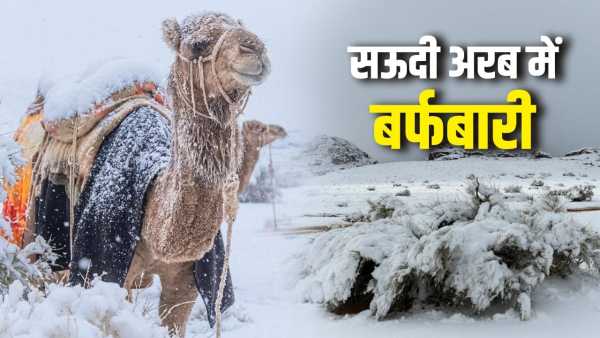
A white blanket of snow spread across Saudi Arabia's Tabuk, Al Jawf, Tuwaiq Range and areas near Riyadh.
Saudi Arabia, a desert country in the Middle East, is generally known for its scorching heat, dry winds and year-round sand dunes. But recently the world saw a different picture here. A white blanket of snow covered Tabuk, Al Jawf, Tuwaik Range and areas near Riyadh. In many areas the temperature dropped to minus 4 degrees Celsius. In places where only sandstorms had been seen for decades, people looked at the heavy snowfall with awe and some certainly enjoyed it.
It is being told that such widespread snowfall occurred in many desert parts of Saudi Arabia after about 33 years.It is natural to raise the question that how did snowfall suddenly occur in such a dry and hot desert? Meteorology, geographical location and changing climate all play a role behind this. Let us try to understand it from different aspects.
Most of Saudi Arabia falls in the sub-tropical desert climate zone. That means very little rainfall. The average rainfall in many areas throughout the year is less than 100-200 mm. In summer the temperature reaches 45-50°C in many parts. The days are very hot and the nights are cold. In winter, the night temperature can go near or even below zero in some high altitude areas.
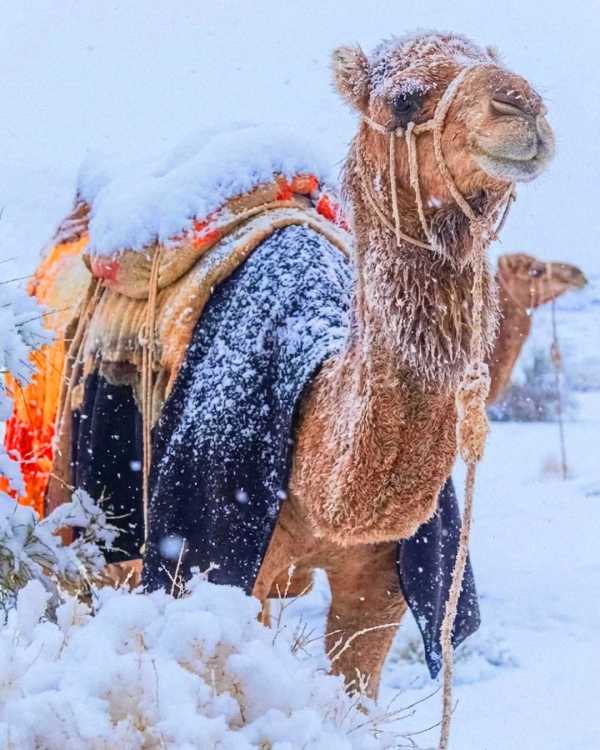
Photo of snowfall in Saudi.
The northwestern mountainous regions, such as Tubuk Province, Jabal al-Louz and the high plateau, have previously experienced occasional frost or light snowfall in winter. That is, snowfall was never completely impossible, but it was often limited to small areas at limited altitude, and that too for short periods of time.
The event of December 2025 is being called the first major snowfall in 33 years because it occurred on a very large scale. According to reports, snow was seen extending from the Tuwaiq Mountains to areas around Riyadh, and into the desert areas of Tabuk and Al Jawf provinces. White sheet like situation was seen in thousands of square kilometers. Earlier, light snow or frost was seen mostly on the high hills, but this time snow was seen accumulating even on the flat desert areas. At many places the temperature went down to minus 4°C, which is much below the average for the desert climate.
There was intensity of rain and cold wave in Tabuk, Hail, Al Jawf, Tuwaik Range, Northern Frontier Regions as well as some eastern and central areas. The sight of camels walking among the snow covered dunes in front of our eyes is enough to describe the extraordinaryness of this incident.
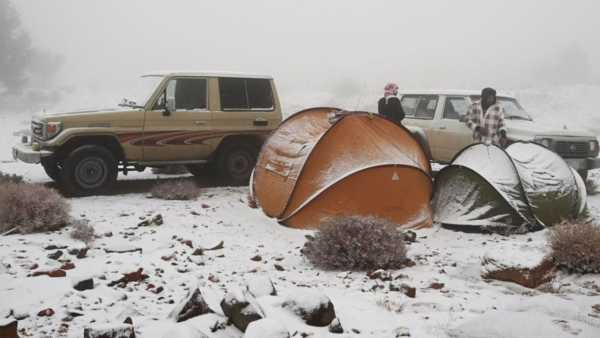
many of saudi Snow was also seen accumulating on the flat desert areas. Photo: @LifeSaudiArabia via
The immediate meteorological reasons mentioned behind this snowfall in Saudi Arabia's National Meteorological Agency and various international reports can be understood in simple language.
#BREAKING-🇸🇦 Meanwhile in Northern Saudi Arabia
Snowfall across hundreds of miles of desert.
No its normal, yes there are well known Weather Modification programs across Suadi & The UAE#SaudiArabia #snowfall #UpdateNews pic.twitter.com/fjmZ4Nfr7a
— Sujon Ahmed 🇧🇩🇺🇸 (@SAexploring) November 3, 2024
It would not be scientifically correct to say that climate change alone caused snowfall, but it is certain that climate change affected the intensity and pattern of this phenomenon. Meteorologists and experts associated with the World Meteorological Organization (WMO) believe that the Arab region is warming at almost twice the rate of the global average. Increasing temperatures mean that the atmosphere can hold more moisture. Due to this, the occasional rains and storms become more intense and extreme. Due to climate change, the average temperature increases, but at the same time the atmospheric currents (jet stream etc.) become unstable. The southward bending of the jet stream causes very cold air to suddenly reach lower latitudes (such as the Middle East).
The result is sometimes abnormal heat, sometimes sudden floods and sometimes desert snowfall seen after a long time. The torrential downpours, flash floods, hailstorms and now this snowfall that have hit the Arabian Peninsula in recent years all indicate that weather is now more unpredictable and extreme than ever before.
Snowfall has already been recorded in the high altitude northern areas of Saudi Arabia. In the year 1992, the record minimum temperature of minus 9.3°C was recorded at the high station. In 1973, there is mention of about 20 cm of snow falling in Riyadh. The difference is that then the events were relatively limited geographically, there were no social media and instant information systems and the discussion of climate change was also not so prominent at the global level. The visual impact, media coverage and climate context of the 2025 snowfall combined to make it a historic and global talking point.
Wow. Heavy snow storm is underway in Tabuk #Saudi Arabia.
These camels look so confused: pic.twitter.com/ScxqiiYCfC
— Joyce Karam (@Joyce_Karam) February 18, 2021
Due to snowfall, people came out of their homes and started having snowball fights and photography on the desert slopes. In many areas, authorities issued traffic warnings, implemented online classes in schools and appealed to citizens to exercise caution. From a health perspective, the elderly, children and those with pre-existing medical conditions are more vulnerable to sudden cold surges; The government issued an advisory for them.
The event also brings with it the potential for winter tourism. The NEOM project being developed under Crown Prince Mohammed bin Salman's Vision 2030 and the Trojena included in it have already been selected to host the 2029 Asian Winter Games. Such a huge natural snowfall gave a natural promotion to this plan, because people from all over the world saw Saudi covered in such extensive snow.
On one hand, Saudi Arabia is one of the largest oil producers in the world, on the other hand it is also emphasizing on renewable energy and green initiatives. Such incidents intensify the debate in international forums about how oil-based economies should view and reduce their role in climate change.
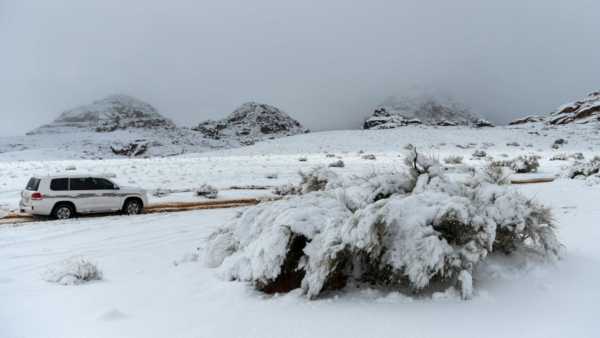
Pictures of snowfall in Saudi Arabia are going viral on social media. @LifeSaudiArabia via
Desert countries will also have to be prepared for extreme cold. Infrastructure, roads, power supply, water supply and disaster management systems will have to be designed not just for heat and drought, but also for occasional snowfall and flash floods. Long-term research on air circulation, jet stream conditions, sea surface temperatures (SSTs) and polar air mass pathways over the Arabian Peninsula has become important, so that such extreme weather can be better predicted in the future.
Climate discussions often focus on coastal areas, polar glaciers and rainforests. Events like the one in Saudi show that even deserts are not immune to the effects of climate change, and that populations, economies and ecosystems there are also at risk.