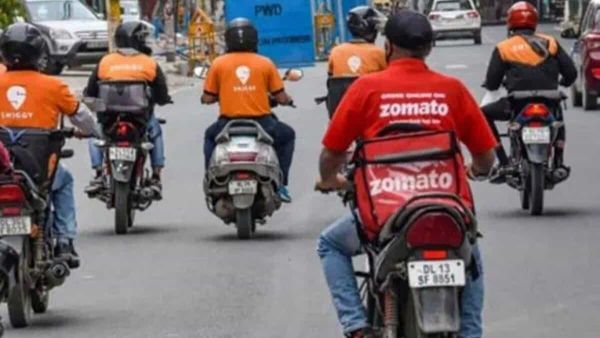
Hyderabad: Gig and platform workers on Wednesday, December 31, have announced a two-day, all-India strike on Christmas (December 25) and New Year’s Eve (December 31), two of the busiest days of the year for delivery workers, to protest against worsening work conditions.
According to the Telangana Gig and Platform Workers Union (TGPWU), the strike has been called to protest the denial of fair wages, safety, dignity and social security of delivery workers.
“Despite being the backbone of last-mile delivery — especially during peak seasons and festivals — delivery workers are forced to endure long working hours, falling earnings, unsafe delivery targets, arbitrary ID blocking, lack of job security and absence of basic welfare protections,” said TGPWU president Shaik Salauddin in a press release.

In a video shared on X, gig workers from across the country, who work for aggregator platforms such as Blikit, Swiggy and Zomato, said that the payout for riders has decreased and targets have been increased.
They urged delivery riders across the country to stay indoors on December 25 and 31, since the largest number of orders are placed during these days.
India’s Ministry of Labour and Employment has defined gig workers as “a person who performs work or participates in a work arrangement and earns from such activities outside of a traditional employer-employee relationship.”
In 2020, gig workers were included in the domain of labour laws for the first time by the Ministry of Labour and Employment through the Code on Social Security, which makes social protection schemes for them compulsory.
From 7.7 million in 2021 to 23.5 million by 2030, India’s gig and platform workforce is expected to grow exponentially, according to a report by NITI Aayog. However, experts have raised concerns over unfair labour practices and outright exploitation.
Several states, such as Jharkhand, Karnataka, Telangana, and Rajasthan, have introduced legislation to ensure that these workers have basic rights, more than 10 years after gig and platform work took the nation by storm.
The Telangana government drafted a bill titled the Telangana Gig and Platform Workers (Registration, Social Security and Welfare) Bill, 2025, in April, which the state Cabinet approved in November. It includes the establishment of a social security and welfare fund for the workers, mandatory payments by aggregator companies to the workers, the introduction of a grievance redressal mechanism, and setting up a gig and platform workers’ welfare board.
The TGPWU has been closely involved with the development of this legislation.
However, critics have raised concerns, saying that the Bill lacks a minimum wage guarantee, weak representation on welfare boards, insufficient detail on benefits, potential for broad definitions to misclassify workers, exclusion of street vendors, and concerns over funding responsibility.
According to the press release of TGPWU, some of the demands of the gig workers, which are the core reasons for the strike, include fair and better pay through transparent wage structures and incentives reflecting real working hours and costs. They also demanded that the arbitrary blocking of IDs and penalties without due process be stopped and they receive improved safety measures, including safety gear and accident insurance.
The other demands were assured and consistent work allocation without algorithmic discrimination, and respect and dignity at work, including humane treatment by platforms and customers, and job security and social security such as health insurance, accident coverage and pension benefits.
In the statement, Salauddin said that the unchecked algorithmic control exercised by platform companies “has pushed delivery workers into deep economic insecurity, forcing excessive work hours while shifting all risks onto workers.”
The gig workers also urged the Centre and states to immediately regulate aggregator companies and enforce labour protection.
This strike reflects the growing nationwide unrest among gig and platform workers.