What appears, on the surface, to be an isolated disciplinary action has rapidly snowballed into a larger political and academic controversy.
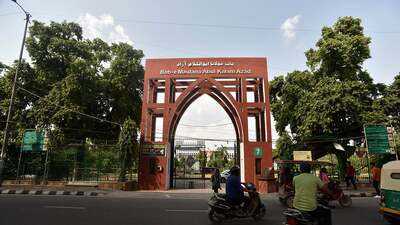
Jamia Millia Islamia has suspended a professor for setting an examination question asking students to “discuss the atrocities against Muslim minorities in India, giving suitable examples.”
The question featured in the BA (Hons) Social Work Semester I paper titled ‘Social Problems in India’, was prepared by Prof. Virendra Balaji Shahare.
Photographs of the question paper went viral on social media, drawing sharp objections from some quarters especially from the right-wing trollers, with even apprehensions being voiced about the filing of an FIR against the professor.
Following the uproar, the university ordered an inquiry and placed Prof. Shahare under suspension.
In an office order dated 23 December, Jamia said it had received multiple complaints from various sources regarding the content of the end-semester examination paper for the 2025–26 academic session.
Invoking Statute 37(1) of the university statutes, the Vice-Chancellor suspended the professor with immediate effect, pending the outcome of the inquiry.
The move has drawn strong condemnation from the Students’ Federation of India (SFI), which termed the suspension an attack on academic freedom. In a statement, the students’ body said:
“The suspension is not just a punitive act; it is a threat to Jamia’s core values of debate and dissent. We stand with Prof Shahare and demand immediate revocation of the suspension. Jamia will not become an RSS outpost. Academic freedom must be defended.”
Meanwhile, the Delhi University Teachers’ Association (DUTA) joined the chorus, circulating the question paper and describing the episode as a matter of “serious concern”.
DUTA alleged that the question promoted a “one-sided narrative” in a centrally funded university and called for an immediate review of both the paper and the syllabus. The association urged the Ministry of Education and the University Grants Commission to take note of the issue.
The episode has reopened an old fault line in Indian academia: where does academic inquiry end and political offence begin? Critics argue that the suspension sends a chilling message to teachers, particularly in the social sciences, where uncomfortable questions about society are not just inevitable but essential.
Supporters of the action, however, insist that publicly funded institutions must ensure neutrality and avoid framing that could be seen as communally partisan.
For Jamia, long known for its culture of debate and dissent, the outcome of the inquiry will be closely watched—not merely as a disciplinary matter, but as a litmus test of how much intellectual autonomy still survives on Indian university campuses.