New Delhi:In most countries of the world, Christmas is celebrated on 25 December, but in Russia this festival falls about two weeks later, on 7 January. Here the glow of Christmas is different; the lights are lighter, the streets are quiet and the atmosphere feels more like stagnation than celebration. This difference is not just a matter of date, but a deep story to faith, history and traditions.
Russia chose the path where traditions were more important than the pace of time. The world kept moving forward, but Russia preserved its religious customs in the same form as they were centuries ago. This is the reason why the style of Christmas there looks completely different from other countries.
The date of Christmas in Russia has its roots many centuries old. There was a time when the entire Christian world followed the Julian calendar. In the year 1582, most of the countries of Europe adopted the Gregorian calendar, so that the difference between seasons and dates could be corrected.
However, the Russian Orthodox Church retained the old Julian calendar for religious events. This decision still gives direction to the religious life of Russia. Everyday functions in the country are according to the Gregorian calendar, but the Church celebrates its festivals according to the Julian calendar. Over time, there was a difference of 13 days between the two calendars, and due to this the Church’s December 25 becomes January 7 for the world.
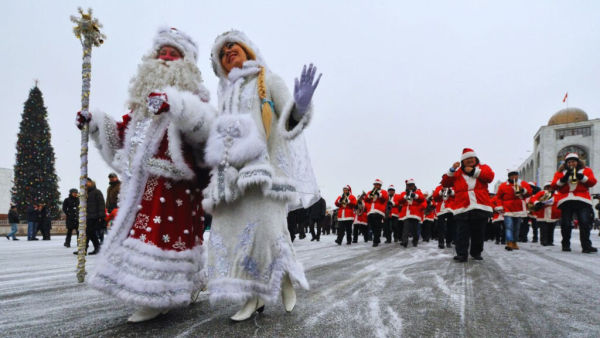
The difference in this date has changed the entire identity of Christmas in Russia. While in other countries there are gifts, countdown and fireworks on Christmas, in Russia it is all to New Year’s night. On New Year’s Eve, families gather under decorated trees, children wait for Ded Moroz and cities are filled with twinkling lights.
Christmas, which comes after the hustle and bustle of the New Year, brings a spiritual atmosphere in Russia. Here there is neither the pressure of expensive gifts nor the competition of grand parties. This day feels close to traditions and faith.
In many homes, strict fasting is observed on the evening before Christmas. On this occasion, a meal of 12 traditional dishes is prepared, which does not include meat. This food is prepared in honor of the apostles. According to tradition, no one eats food before the first star appears in the sky, turning the cold night into a special spiritual moment.
When folklore comes alive
The days after Christmas are called ‘Swiatki’. This is a time of laughter, tea and traditional predictions. Children walk through the streets holding star-shaped decorative signs and sing traditional carols ‘kolyadki’. Neighbors welcome them with sweets and pastries and the sound of songs echoes in the snowy courtyards till late at night.
These days, Ded Moroz and his granddaughter Snegurochka are also seen in city squares and parks. They arrive not through chimneys, but wearing embroidered coats, singing songs and giving gifts to children. In Russia they are more associated with New Year celebrations than Christmas.