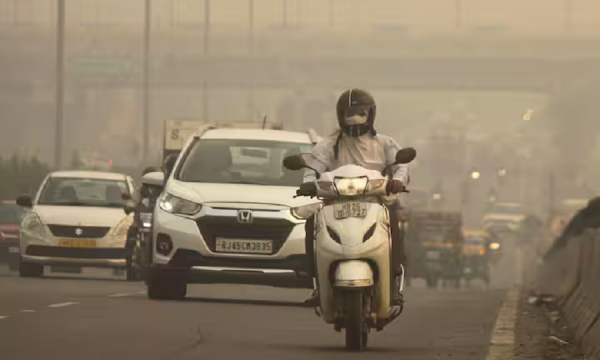
Under the Graded Response Action Plan, more than 1.05 lakh PUCC (Pollution Under Control Certificate) challans (fines) were issued from October 14 to the end of November. Of these, approximately 78 per cent, or 82,774 challans, were issued to riders of motorcycles and scooters.
The Delhi Traffic Police are continuously increasing their enforcement of pollution control regulations. Despite this, a large number of vehicle owners are taking the PUCC requirement lightly. The statistics clearly show that two-wheelers are the biggest offenders when it comes to violating these rules. Not obtaining a PUCC, driving with an expired certificate, and repeatedly breaking the rules is now considered a habit rather than a mistake.
Under the Graded Response Action Plan, more than 1.05 lakh PUCC challans were issued from October 14 to the end of November. Of these, approximately 78 per cent, or 82,774 challans, were issued to riders of motorcycles and scooters. This clearly means that four out of every five vehicles found violating PUCC rules were two-wheelers.
Interestingly, no cars are included in the list of the top 5 vehicles violating PUCC rules in Delhi. This list includes a 2016 model Passion Pro, which received 47 challans. A 2018 model Passion Pro received 38 challans. A 2022 model Splendor also received 38 challans. A 2018 model TVS Jupiter Scooty received 37 challans, and a 2021 model Yamaha Ray ZR Street Rally received 35 challans. In the case of the Yamaha, the owner never even bothered to obtain a PUCC.
The case of the Yamaha Ray ZR Street Rally is the most shocking. The vehicle's PUCC was neither expired nor was its renewal forgotten. Instead, the owner never bothered to obtain a PUCC in the first place. Despite this, the vehicle was continuously being driven on the roads. Under Section 190(2) of the Motor Vehicles Act, 1988, every vehicle operating in a public place is required to have a valid Pollution Under Control Certificate (PUCC). New vehicles obtain a PUCC one year after registration, while older vehicles must renew it every six months. For vehicles that emit excessive pollution, this period may be reduced to three months.
Before 2019, the maximum fine for not having a PUCC was ₹2000. After the amendment, the penalty for the first offence includes a fine of up to ₹10,000, suspension of the driver's license for up to three months, and even imprisonment. For repeat offences, the fine can reach ₹20,000. In Delhi, this is being strictly enforced through e-challans.
According to the traffic police, those who repeatedly violate the PUCC rules are considered habitual offenders. Cases with more than 10 pending challans are not treated as mere negligence but as deliberate disregard for the law, and such cases are taken to court.
Furthermore, data reveal a lack of seriousness among two-wheeler riders regarding these regulations. Many do not obtain insurance, nor do they transfer ownership, believing that the rules only apply to cars.