
Bali is a cocoon: its outer shell softening the noise of modern life while its inner world is nourished by three quiet forces: devotion, community, and divine warmth. It’s what keeps the island suspended in its own rhythm, untouched yet overflowing. Then there is Jumeirah; synonymous with Arabian hospitality, opulence, and a level of care that feels almost ceremonial in itself.
What a marriage when combined.
Perched above the fittingly named Dreamland Beach, Jumeirah Bali rises in sweeping whites and Majapahit-inspired geometry. Light lands where it might otherwise go unnoticed. Like makeup done right, it doesn’t mask Bali; it highlights her.
I’ve lived on this island for three years. I know her shortcuts, her ceremonies, the way she breathes. And yet, I had never seen Bali with this kind of framing, a way of seeing that draws out beauty you thought you already understood. What a marvel. Here is what unfolded after four days of Bali, the luxury edition.
DAY 1 - THE ARRIVAL
A fizzing started in my stomach as the grand gates pulled open. I rolled down my window, and the sound of gamelan (metallic, melodic, unmistakably Balinese) rushed into the car and met my excitement beat for beat. Walking into the lobby, I almost dropped my jaw. The horizon opened like a curtain: the ocean stretching endlessly ahead, framed by cavernous ceilings, opulent whites, and space (so much space!). My body softened instinctively, the way it does when stepping into a sanctuary. A cocoon within a cocoon.
Of course I’d looked at the website before my arrival, but the human eye sees panorama in a way the camera can’t catch. Light slipped playfully through the carved panels and shone across the marble, catching details the lens would flatten into nothingness. I could hardly believe the resort is only four years old... it had a timelessness about it, as if it had always been here. Made, the manager, gave us a tour of the property, and the attention to detail was immaculate: tiles made in a factory built solely for Jumeirah’s floors, stone carved with ceremonial precision. He led us to our Ocean Front Pool Villa, and I understood why this category exists.
The 185-square-metre space is split between a bedroom that opens entirely to the terrace and a bathroom that redefines the concept. An outdoor rain shower surrounded by tropical plants, an indoor monsoon shower, and a freestanding stone bathtub positioned to frame the ocean. His-and-hers vanities in Palimanan limestone, Diptyque amenities, and the kind of robes that make you consider theft (don’t, they’re monogrammed). But it’s the terrace that steals focus: a 10-metre infinity pool appearing to spill into the Indian Ocean, flanked by sunbeds on one side and a generously cushioned sofa under a shaded pavilion on the other. Our butler, Ari, handed me her WhatsApp number and gestured to the phone by the bed. “24/7,” she said.
Not a sales pitch. A promise. That evening, I found a bookmark lovingly placed into the book I’d left by the pool. Kind of like a kid at Disneyland, while I knew this wasn’t real life, I was totally submerged in the Jumeirah experience.
DAY 2 - THE UNPLANNED MAGIC
The next morning unfolded the way Bali mornings often do: slowly, softly, and without any urgency to be anything other than what they are. Breakfast at Segaran became my daily ritual. The buffet sprawls across live cooking stations (made-to-order nasi goreng, fluffy pancakes, eggs any style) and a patisserie section that rivals Paris.
I settled into a pattern: fresh coconut water, tropical fruit salad heavy on dragon fruit and mangosteen, then eggs Benedict while watching surfers dot the waves below. The space itself (open-air, ocean breezes, that endless blue horizon) made lingering over a double espresso an ‘essential.’ A gardener proudly presenting a newly blossomed frangipani. A waiter remembering my coffee order without needing to ask. The buggies appearing precisely when needed, drivers somehow intuiting when we’d finished at the pool or were ready for the spa. And at the spa, they calculated my chakra through numerology and told me mine is the heart. Funny that. These moments were gentle, human, and stitched together with the quiet ease that Bali carries so naturally. But the pinnacle came that evening: a private dining experience at Mantra Dine, arranged by Angelika.
We descended via a glass elevator into the cliffside, emerging into a subterranean sanctuary where natural stone textures met soft candlelight. The dining room felt like a secret kept underground, built around a magnificent wooden table (essentially half a tree trunk, its organic edges preserved), surrounded by walls lined with antique wine bottles that told their own stories.
Chef Joan Achour, who brings years of experience from Michelin-starred restaurants in Europe and Jumeirah properties across the world, arrived first to discuss preferences. Then she disappeared to create a six-course tasting menu that balanced French technique with Indonesian soul. Seared scallops with sambal matah and finger lime. Beef tenderloin with black garlic purée and Balinese long pepper. A deconstructed pandan crème brûlée that tasted both familiar and revelatory.
This was theatre, intimacy, and precision that justified every dollar. There was something greenhouse-like about the whole day; a sense of being protected while quietly expanding into yourself. It reminded me why I moved to Bali in the first place, to give myself room to unfurl. Away from the rush, the pressure, and the versions of me I’d outgrown. It was Bali that taught me to follow the white rabbit: to be curious, to be brave, to let wonder lead the way. How poetic to now write an ode to the very place that helped me discover the writer within.
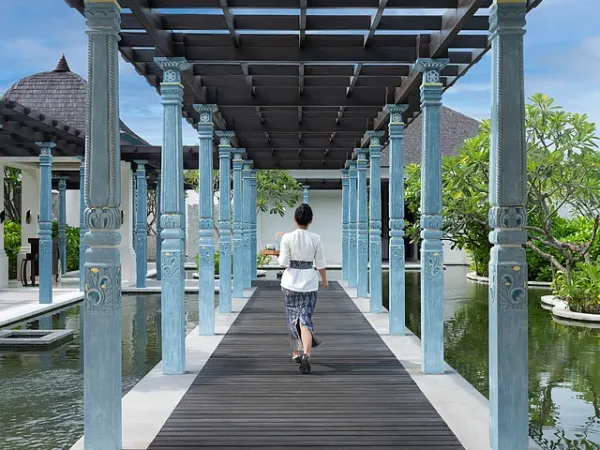
DAY 3 - THE STILLNESS
On the third morning, my mind drifted back to the funeral procession I’d passed on the way to the hotel. In England, funerals are all dark coats, lowered voices, and a long line of black cars. Here, it looked nothing like that. Dark clothes replaced with vibrant colour. Tears softened into smiles. Limousines swapped for motorbikes weaving gently through traffic. Traffic stopped instinctively as the tower looped through the crossroads.
In Bali, when ceremony passes, everything else yields. And instead of a polished hearse, a towering, gold-trimmed ceremonial coffin was carried on the shoulders of men moving as one. The whole structure swaying gently as they navigated the road. Others ran ahead with long bamboo poles, lifting the electrical cables so the tower could pass beneath them without stopping. It wasn’t solemnity; it was choreography. Communal, joyful, reverent all at once. And in that moment, I understood something essential about Bali: here, even grief participates in life. Sorrow expands rather than shrinks. The community gathers, lifts, carries (literally and symbolically) as if offering the same phrase I’d been hearing since I arrived: enjoy the life. An easeful way of holding everything: joy, loss, beauty, impermanence.
And that same balance revealed itself at Jumeirah in quieter, more intentional ways. For travellers seeking tranquillity without isolation, the resort offers spaces shaped for unwinding. The private pools deepen in colour at dusk, the tide pulls steadily against the cliffs below, and afternoon tea becomes a daily ritual worth keeping. Warm cups, shifting light, soft ambient music. Each villa is a self-contained haven: private pool, palm-framed terrace, generous interiors softened by teak wood, Palimanan stone, and filtered light through floor-to-ceiling windows. They suit travellers who want privacy without losing connection to the landscape.
You’re sheltered but not sealed off; held, yet still part of Uluwatu’s wild edge. The location amplifies that feeling. Positioned on one of Uluwatu’s quieter cliff lines (just 15 minutes from Uluwatu Temple, one of the island’s oldest), the resort overlooks a stretch of coastline known for its wide skies and uninterrupted sunsets rather than the busier, more touristed beaches nearby. It’s close enough for day trips to temples, surf spots, and beach clubs, yet tucked far enough away that mornings begin with birdsong and a warm offshore breeze.
The airport sits 40 minutes away in light traffic, Seminyak 45 minutes north. The spa, surrounded by water gardens, accentuates the calm through its offerings. I’d booked the signature facial with sound healing: a 90-minute journey beginning with that chakra numerology reading before the therapist customised the treatment. They use a premium Balinese line (frangipani, volcanic clay, coconut, turmeric), and the facial itself was technically excellent: proper extractions, lymphatic drainage, a shoulder and scalp massage that nearly put me to sleep. Then the sound healing: singing bowls placed around my body, their vibrations creating a meditative state that lingered long after. Post-treatment, the spa’s heated infinity relaxation pool (surrounded by daybeds and frangipani trees) is where you should plan to spend at least an hour.
Cucumber water, tropical fruit skewers, and that particular kind of silence that feels expensive. The gardens invite slow wandering, with lotus ponds and sculpted greenery arranged to frame the ocean rather than distract from it. Ari’s response time was exceptional: fresh towels within five minutes, a private driver to Uluwatu Temple arranged before I’d finished my coffee. The turndown service went beyond chocolate on pillows: curtains drawn, air conditioning adjusted, aromatherapy diffuser lit, robes arranged on the bed with the next day’s weather forecast and a handwritten note suggesting activities. Jumeirah suits the traveller who values space, quiet, and the feeling that nature is part of the luxury itself. The staff’s intuition and gentleness make the experience feel effortless.
Akasa, the rooftop restaurant, offers flame-grilled Asian fusion cuisine and arguably the best sunset perch in Uluwatu, where fire-touched dishes meet panoramic ocean views. Stillness here is attraction over promotion. It appears naturally, the way the best parts of Bali do, reminding you that the real luxury isn’t just the setting, but the softening it allows. Transformation... the final purpose of any cocoon.
Enjoy the life
By the final afternoon, the terrace was drenched in gold. It reminded me that the truest luxury here was never the marble or the villas, but the same golden threads that form Bali’s cocoon: devotion, community, and divine warmth. Jumeirah Bali occupies the premium end of Uluwatu’s luxury spectrum (Ocean Front Pool Villas from around $1,200 (Dh4,400 approximately) per night, rising to $5,000+ for multi-bedroom configurations in peak season). What distinguishes it is its particular alchemy: Arabian service precision (anticipatory, formal without being stiff, genuinely intuitive) synthesised Balinese warmth.
It suits couples seeking privacy, families requiring space without sacrificing sophistication, UAE residents who appreciate Jumeirah’s signature hospitality in an unexpected setting. Book if you want a clifftop sanctuary where you can disappear for days without feeling isolated. Skip if you need direct beach access or prefer to be in the centre of Uluwatu’s social scene.
Travel: Why Mérida is home to Spain’s best-preserved Roman ruins Travel: A 2-day itinerary for your getaway to Mallorca in Spain