
In boardroom huddles between CXOs and cafe meetings between startup founders, AI is no longer the last word or a prickly subject. It’s not something people are sceptical to talk about, and, in fact, many are happy to stick their necks out and share their AI predictions in 2026.
Before we get started, it’s hard to talk about AI without acknowledging that it has an impact on pretty much every sector and app out there. At the same time, AI-native startups have become a focal point, along with startups building the infrastructure and rails for an AI future. It’s hard to predict which part of the AI ecosystem will gather the most momentum.
What we know is that Indian tech companies and startups have raced from pilots to production so quickly that nearly half of the large enterprises now run multiple AI use cases live. As highlighted in Inc42’s upcoming Annual Indian Startup Trends Report, 2025, India is home to more than 1,20,000+ AI professionals and 185+ AI/ML GCC hubs, which make the country a frontline base for model development, MLOps, automation, and predictive engineering.
Inc42 predicts that up to 15–20 AI-native and deeptech startups are likely to emerge in 2026 as GCC spin-outs, led by globally trained operators.
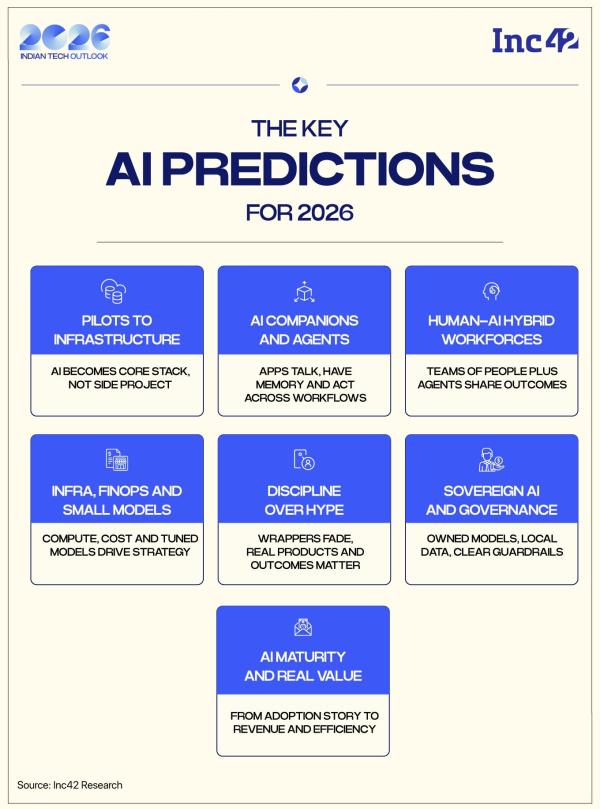
This is the backdrop against which 2026 arrives: a year where AI stops being a side project and becomes the way Indian companies are built, operated, and secured. Government programmes like the IndiaAI Mission are pouring capital into indigenous models, compute and infrastructure. Founders are rebuilding everything from contact centres to core banking on top of agents, small models, and voice‑first interfaces for an AI world.
This concoction can unlock a whole lot for the Indian tech economy.
In 2026, AI will be treated as critical infrastructure; apps will turn into AI companions; agents will step into real workflows; and infrastructure, cost, and governance will continue to remain make‑or‑break questions, but with clearer answers on each front.
The Shift From Pilots To InfrastructureEnterprises are rewriting systems and rebuilding their architecture to ensure AI is embedded into the core, not sprinkled on top. Discussions are now less about discovery of AI capabilities — some of that has already been done in 2025 — but more about uptime, latency, FinOps, and governance.
Anindya Das, the cofounder and CTO at AI cloud company Neysa, believes that 2026 will result in the end of experimentation and the beginning of AI accountability. “Enterprises are now designing AI as critical infrastructure. That changes every decision around architecture, cost, security and ownership,” Das told Inc42.
Teams are moving toward smaller tuned models, hybrid deployments, and full‑stack control because performance, governance, and cost predictability can’t be outsourced anymore.
Behind the scenes, this hardens the economics of AI. With the bulk of AI cost sitting in compute capacity, disciplines like AI FinOps and infrastructure observability are becoming non‑negotiable. “By 2026, the organisations that succeed will be those that treat AI as a utility with clear engineering foundations,” Das added, claiming that engineering discipline will become as important as model quality in 2026.
Ecosystem Moves Towards DisciplineFor all the momentum that is being promised by founders, not every AI product in India today will survive to see 2026 in production. A lot of systems still sit in a grey zone between demo and viable business. This grey zone will become narrower and narrower, squeezing out real value and the hype at the same time.
“If I were to make a one‑year statement on AI, I think we are still in a hype phase,” says Deepak Dhanak, cofounder and COO at AI coding platform Rocket.new. “There is a lot of dust right now and that dust needs to settle and then we will come to know what the real products are and what’s just a cheap wrapper on LLMs.”
The exploratory phase for any new paradigm in tech is filled with commotion, marginal players, and inflated claims, and despite sounding pessimistic about the current situation, Dhanak believes that in the long run the value will undoubtedly emerge.
“It is going to tremendously help us move forward much faster than we have anticipated, but with AI we need to exercise caution in terms of differentiating a real result from a perceived result.”
Does this mean that 2026 will bring in stricter evaluation frameworks, more transparent metrics, and a bias toward real customer value over novelty? Not quite clear, at the moment, companies are not throwing money at AI as one may believe. With bigger budgets, accountability will surely be needed on AI best practices.
Inc42’s annual founder survey for 2025 shows that just 10% of companies spend INR 1 Cr annually on AI, and serious deployment remains rare, but that could change in 2026.
AI Enters Serious Business ModeIf the last three years were about chatbots and copilots, 2026 is when AI companions and agents quietly become the default interface.
Founders say users will not open apps to take actions, but talk to a voice companion or an intelligent layer that understands context, triggers workflows, and learns over time. “All the apps will become AI companions in 2026,” Ashutosh Prakash Singh, cofounder and CEO at RevRag.AI, boldly claimed.
RevRag, which makes an AI agent for revenue teams, is one of the companies enabling a companion for enterprises within their existing apps.
According to Singh, the shift means products will be judged less on static features and more on the quality of their memory, autonomy, and ability to coordinate across tools. Apps will feel less like software and more like collaborative colleagues that know your history, your constraints, and your goals.
Others agree on this direction in the app and software ecosystem. AI may not kill software, but it will certainly find a home in every piece of software out there.
For enterprise workflows, this companion layer evolves into a full agentic operating layer. “In 2026, agentic systems will become the default operating layer for customer operations, risk, and service workflows,” says Ganesh Gopalan, cofounder and CEO at Gnani.ai, which is also developing agentic AI for enterprises.
The Gnani CEO sees small language models and speech‑to‑speech architectures driving higher precision, lower latency, and stronger compliance in regulated environments. Voice AI could be leading this change from the front. According to Gopalan, 2026 will be the year AI agents move from conversation to action and become embedded into core enterprise workflows.
Human–AI Collaboration In Full ForceAs agents and companions scale, the bigger disruption will not just be technological — it is about how work itself is structured. The future is less about people using tools and more about hybrid teams where humans and AI agents jointly own outcomes. After all, an AI agent is just another name for a worker, but used in the right manner, it can supercharge productivity instead of replacing human productivity.
“AI will not assist the workplace, it will be the workplace,” argues Shayak Mazumder, founder and CEO at Adya.ai.
“A human on their own can do maybe 45% of the task. AI by itself will probably be able to go 55%. But a human agent in collaboration which we call HAI does 65%,” Mazumder claimed in a conversation with Inc42.
He believes that under existing frameworks, hybrid human–AI models can bring scale without increasing headcount. This will radically change company structures.
“Today, there are a few large companies and everybody goes there to work. Tomorrow, there won’t be so many jobs in those large companies because they will be mostly done by AI,” he says.
He believes that such hybrid teams can operate interoperably, a world where AI-empowered individuals and small teams build ventures around their own AI capabilities and partner with each other. This picture sounds utopian but is a real possibility given that we have not yet experienced such skill disruption at scale.
The True Cost Of AI Becomes ClearAll these possibilities of AI’s disruptive wave will not stand up to the test of any amount of time without the right infrastructure. This is now the primary constraint and the primary differentiator. India’s AI data centre build‑outand GPU investments are a direct response to this bottleneck.
“Infrastructure has become the primary constraint and the primary differentiator,” added Neysa cofounder Das. As inference workloads explode, most of the spend and complexity moves to how models are served and optimised rather than just how they are trained. This is driving teams toward hybrid deployments across cloud, edge, and on‑prem, especially where data sensitivity and latency really matter.
Akshat Mandloi, cofounder of LLM maker Smallest.ai, believes the cost reality will push “continual learning” and “small models with memory layer” into the mainstream.
“Their adoption in real time conversational voice AI is going to solve some core challenges,” he noted.
Inference optimisation will be a major priority going forward as enterprises see more and more benefits from lowering the compute and memory footprint of models, and thereby the cost. “Smaller, domain‑adapted models with memory layers and aggressive optimisation are emerging as a pragmatic alternative to one‑size‑fits‑all giants,” Mandloi added.
The Evolution Of Sovereign AI?Another thread running throughout 2025 was sovereign AI and governance. Model ownership, data control, and policy alignment are no longer niche concerns but first principles questions for Indian founders and CIOs.
This is exactly the transition Gnani’s Gopalan points to when he says that sovereign and responsible AI frameworks will move from policy discussions to hard deployment requirements.
“As regulatory expectations tighten globally, enterprises will be judged on how securely and measurably they can deploy agentic systems at scale. Each major company needs to show that its AI works, but also that it works predictably, safely, and in line with local norms.”
The age of unclear regulations will come to an end by the end of the year, according to many of the founders we spoke to. One reason is that the Indian government and the tech ecosystem wants AI adoption en masse.
India’s mix of large‑scale digital infrastructure, demographic, ambitious AI missions, and a very price‑sensitive market is likely to produce a distinctive pattern — smaller, domain‑tuned, continually learning models running on hybrid infrastructure, wrapped in strong governance and sovereignty.
Founders have described different facets of the same shift: AI moving from conversation to action, from pilot to platform, and from assistive to foundational. For this to happen, some semblance of clarity is needed from those who make the laws and policies.
Adopting AI is a thing of the past; now it’s about real value, efficiency and even revenue generation. 2026 will be the year of great maturity.
The post 2026 And The End Of AI Hype: Cost, Control, And Clarity appeared first on Inc42 Media.