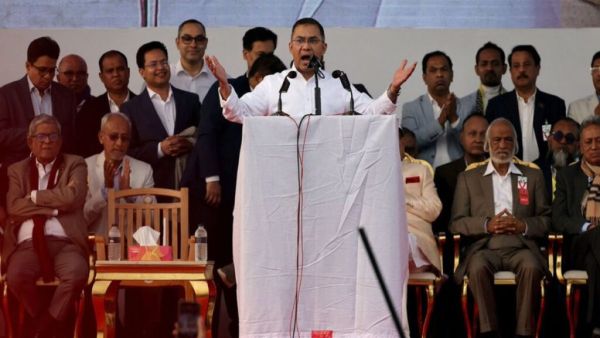
Tarique Rahman Bangladesh return, Bangladesh elections 2026: Acting President of Bangladesh Nationalist Party (BNP) after 17 years in exile tariq rehman ‘s return to Dhaka has intensified the stir in Bangladesh politics. For the first time, India has given a formal response to this development and said that it should be seen in the context of ‘free, fair and inclusive election process’.
Read now on WhatsApp also, click to subscribe
Spokesperson of the Ministry of External Affairs (MEA) of India Randhir Jaiswal Said clearly that India supports free, fair and inclusive elections in Bangladesh. He said, “Inclusive elections mean that all political streams and parties should be involved in the election process, so that democracy is strengthened.” This statement of India has come at a time when the political scenario of Bangladesh is going through a very sensitive phase before the elections proposed in February 2026.
Tariq Rehman was living in London since 2008. He is the son of former President Ziaur Rehman and son of Khaleda Zia. His return is being seen as a demonstration of BNP’s strength. The crowd of supporters gathered on the streets of Dhaka indicated that BNP is considered to be the frontrunner in the election race. As soon as Tariq returned, he visited the grave of his father Ziaur Rehman and paid homage and now he will start the process of registering his name in the voter list and making a National ID card.
Sheikh Hasina government fell after the student movement in August 2024 and she came to India. After this, an interim government was formed under the leadership of Mohammad Yunus. However, Bangladesh demanded Sheikh Hasina’s extradition and the special court in Dhaka also sentenced her to death… but India has not yet given any formal reaction on this. Meanwhile, the Yunus government banned the Awami League, to which India indirectly expressed its disagreement.
MEA has taken a very tough stance on the increasing violence against minorities, especially Hindus, in Bangladesh. India claims that more than 2,900 violent incidents took place during the interim government, including killings, arson, looting and religious persecution. At the same time, India lodged a strong protest against the murder of a Hindu youth in Mymensingh.
Randhir Jaiswal clearly said, “These incidents cannot be dismissed as exaggerated media reports.” India also rejected the Dhaka government’s plea to treat the death of the second Hindu youth as a ‘criminal case’.
There were allegations in the Bangladeshi media that India was allowing Sheikh Hasina to carry out ‘anti-Bangladesh activities’ from its soil. Calling it a ‘completely false narrative’, the MEA said, “The responsibility for law and order in Bangladesh lies with the government there.”
India’s stand currently seems to rest on three points:
However, Sheikh Hasina’s future, Tariq Rehman’s role and the direction of the Yunus government, together, are going to be the real test of India-Bangladesh relations in the coming months.
On the recent violence against Hindus in Bangladesh, Trinamool Congress MP Sharmila Sarkar urged Prime Minister Narendra Modi to intervene in the matter to protect the interests of Hindus. At the same time, Congress MP Tariq Anwar demanded a more active role from the Ministry of External Affairs in the matter of atrocities on Hindu minorities, while Leader of Opposition (LOP) in the West Bengal Assembly Suvendu Adhikari said on Friday that the Mamata Banerjee government is protecting the interests of those who spread violence against Hindus in Bangladesh.