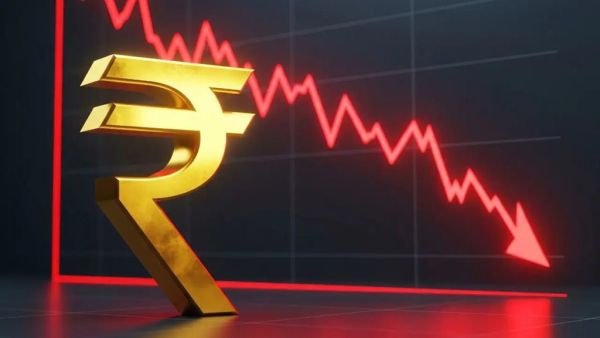
Report: A multinational financial institution called MUFG has predicted that the Indian rupee would continue to weaken till 2026.
It predicted more depreciation of the Indian rupee in a research earlier this month. By the September 2026 quarter, it anticipates that the Indian rupee will have risen slightly beyond the 90 mark in 2026, reaching 90.80.
“Although we see that FX outflow pressures have been more severe than we had first predicted, we have always been anticipating INR to weaken and perform poorly. Our projections also suggest that the Indian rupee would continue to decline versus important foreign exchange crosses including the euro (EUR), the yen (JPY), and the Chinese yuan (CNY),” the paper said.
The Indian rupee may be impacted by increased import demands and soft net foreign direct investment.
The Indian rupee struck a new all-time low in early December when it broke below the 90 mark versus the US dollar, continuing its current run of devaluation.
“We anticipate modest net FDI flows and a larger current account deficit of 1.5% of GDP, which is reflected in our FX predictions. The MUFG research said, “With our expectation of an eventual trade deal between the US and India, where we assume tariffs will be lowered to 25 percent from 50 percent by early 2026, these should offset some improvement in portfolio inflows.”
In light of this, MUFG anticipates that the RBI will aggressively intervene to stop the depreciation of the Rupee.
However, it believes that the fundamentals eventually suggest some pressure on the rupee to depreciate, and because of this, the RBI will finally let the rupee to break above 90 over time.
However, the odds are in favor of further Rupee decline.
“It is true that tariff assumptions have an impact on our projections. Even while India’s internal economy should continue to support India’s total GDP, the bias would shift towards greater INR depreciation and additional RBI rate cuts if a trade agreement between the US and India to slash tariffs is not struck, the report said.
It’s crucial to stress that, given lower FX (foreign currency) values and more impetus for structural reforms that may eventually release the constraining growth restrictions, we are not too pessimistic about the INR (Rupee) at present levels. India’s administration has already accelerated changes like labor law consolidation and GST simplification, which most likely would not have been feasible without the external shock of the 50% tariffs. We believe that FX volatility may be kept within reasonable bounds, unlike previous cycles, given the recent victories the incumbent administration has had in state elections and the growing momentum behind reforms.
Due to improved rural activity, greater domestic demand from GST tax cuts, and the presumption of a trade agreement with the US by early 2026, MUFG increased India’s GDP projections to 7.6% for 2025–2026 and 7.1% for 2026–2027.
“So far, tariffs have had little direct effect on India’s exports in terms of growth, with some goods being diverted to markets like the EU, China, and the UAE. This is not to argue that tariffs won’t have an adverse effect; in fact, we believe that the longer tariffs remain high, the more noticeable the negative effects will be. Our working assumption is that tariffs will be reduced from the present 50% to 25% in early 2026, but they will still be higher than those of India’s main export rivals. As a result, even if exports of products and services may decline, the research states that “we believe the downside should be capped by an expected trade deal.”
According to the MUFG research, domestic demand should get some assistance in 2026 from the delayed effect of looser monetary policy.