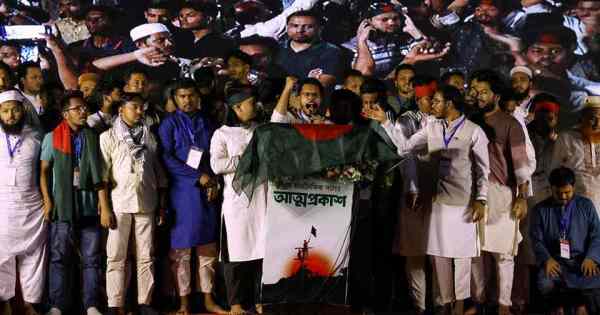
Bangladesh Election Dynamics: As Bangladesh moves steadily toward its next general election, the political landscape is undergoing a significant reshaping. Among the most closely watched developments is the evolving strategy of the National Citizen Party, a relatively new political organization born out of student activism. Once seen as a fresh alternative to established political forces, the party now finds itself navigating internal divisions, uncertain public support, and complex alliance negotiations that could define its future relevance.
The National Citizen Party emerged in the aftermath of the 2024 student-led protests that challenged the long-standing dominance of the Awami League government under Sheikh Hasina. These protests not only altered the balance of power but also opened political space for new actors. The party’s founders envisioned a movement that could translate youth energy, reformist ideals, and public dissatisfaction into a sustainable political platform ahead of the national polls.
The party’s roots lie in a wave of student mobilization that played a critical role in shaping the interim political arrangement led by Muhammad Yunus. Many observers believe that the moral legitimacy of the movement initially gave the party strong visibility, especially among urban youth and online communities. Social media outreach helped the party project itself as modern, reform-oriented, and distinct from traditional political organizations.
However, transforming activism into structured political influence has proven more difficult than expected. While the party gained attention in digital spaces, it struggled to build strong organizational networks at the grassroots level. This gap between online popularity and real-world political presence has increasingly shaped its strategic calculations.
As election preparations intensified, it became evident that the party lacked the local infrastructure required to contest a large number of parliamentary seats independently. Political analysts note that in Bangladesh, electoral success depends heavily on local networks, long-term voter relationships, and organizational discipline. Without these elements, even high-visibility movements face limitations.
Pre-election assessments suggest that established players such as the Bangladesh Nationalist Party remain far ahead in terms of nationwide support, with Jamaat-e-Islami also retaining a loyal voter base. Against this backdrop, the National Citizen Party has been forced to reconsider its original ambition of emerging as a strong third force.
The pressure to survive electorally has triggered deep internal debates within the party. One faction believes that aligning with Jamaat-e-Islami through a seat-sharing arrangement is the most practical option to secure parliamentary representation. Supporters of this view argue that ideological compromises are sometimes necessary in transitional political environments.
Another faction strongly opposes this direction, warning that such an alliance could undermine the party’s founding principles and alienate its original student support base. This disagreement has led to resignations, organizational fragmentation, and public expressions of dissent by senior leaders, highlighting the fragility of the party’s internal cohesion.
Reports indicate that the party may be willing to contest a limited number of seats as part of a broader alliance rather than pursuing an independent nationwide campaign. Discussions reportedly include the possibility of contesting around thirty constituencies, a significant reduction from earlier aspirations.
Negotiations with Jamaat-e-Islami appear to have gained momentum after earlier attempts to reach a political understanding with the Bangladesh Nationalist Party failed. The return of BNP’s acting chairman Tarique Rahman has, however, reopened channels of communication, adding another layer of uncertainty to the alliance landscape.
The prospect of a student-origin party aligning with an Islamist organization has sparked strong reactions across political circles. Critics argue that such a move represents a departure from the ideals of youth-driven reform and risks diluting the moral authority that initially distinguished the party. Some former allies have publicly expressed concern that this shift signals a broader crisis in youth-led politics.
At the same time, pragmatists within the party contend that without alliances, electoral marginalization is almost inevitable. From their perspective, participation in parliament, even with limited seats, offers a platform to influence policy and remain politically relevant.
The unfolding situation reflects broader trends in Bangladesh’s evolving political environment. With traditional parties maintaining strong positions and new entrants struggling to institutionalize support, coalition politics is becoming increasingly central. The choices made by the National Citizen Party in the coming months will not only shape its own future but may also influence how student movements engage with formal politics in the years ahead.
Whether the party can reconcile its internal divisions and present a coherent electoral strategy remains an open question. What is clear, however, is that its journey from protest movement to political contender illustrates both the possibilities and limitations of youth-led political transformation in Bangladesh.