Justice Delayed: The court is still seen as the final option for the average person seeking “unconditional” relief at a time when the foundations of democracy seem to be collapsing ceaselessly. However, the picture is quite unsettling when a rape victim is made to sit on a dharna against a convicted perpetrator—not an accused person, mind you—under the chilly winter sky.
The nation’s conscience has been awakened by the Delhi High Court’s granting of conditional bail to former BJP MLA Kuldeep Singh Sengar in the Unnao rape case. The survivor’s attorney, Mehmood Pracha, has voiced grave concerns about the intent of the Central Bureau of Investigation (CBI), which has been investigating the case since it was turned over to it following a significant public outcry during the Yogi Adityanath government’s tenure in 2018, despite the fact that the CBI, the primary prosecuting agency in the case, has moved the Supreme Court against the December 23 ruling.
“We don’t know whether the CBI would honestly challenge this matter before the Supreme Court. We believe that the CBI has petitioned the Supreme Court just to preserve its reputation and quell public outrage over the Delhi High Court ruling,” Pracha said.
He said that he would go to the CBI headquarters and file a formal complaint on behalf of the rape victim against the case’s investigating officer and other CBI officers who had allegedly supported Sengar during the lower court trial.
before order to provide the survivor some measure of justice in the current situation, Pracha further said that he was getting ready to independently contest the High Court’s ruling before the highest court.
The survivor’s sole comfort is that Sengar, who is now serving an additional 10-year term for allegedly conspiring to kill the survivor’s father while in judicial custody, will continue to be imprisoned. In that instance, too, he would only leave prison after obtaining bail.
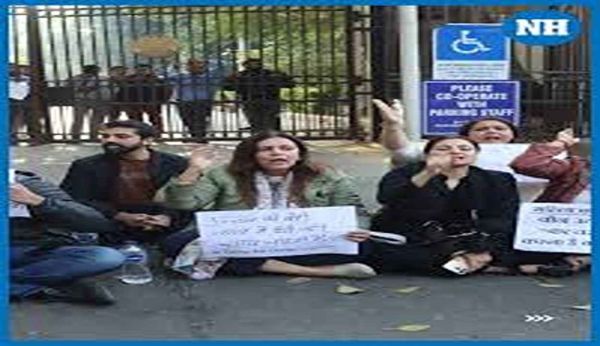
demonstrations over the Unnao rape case’s delayed justice in New Delhi.
In an effort to urge the state administration to take notice of her predicament, a 17-year-old Unnao girl made a valiant attempt to commit suicide outside the highly guarded chief minister’s home in Lucknow during the April forenoon of 2018.
The youngster claimed that Sengar, a prominent BJP MLA from Bangarmau in Unnao at the time, had sexually assaulted her the year before. She also claimed that the system was protecting him.
Following accusations of character assassination and mudslinging, the survivor was ultimately given a voice, and the Uttar Pradesh police eventually filed a formal complaint against Sengar, his siblings, and other people she had mentioned. She knew the fight for justice would be a protracted and difficult one.
After being picked up by district police in connection with a fight involving Sengar’s followers, Sengar was arrested and sent to prison, but not before reportedly planning an attack on the survivor’s father. According to reports, the Unnao police force forced the survivor’s father to persuade his daughter into rescinding her accusations.
In April 2018, the Uttar Pradesh government handed the investigation over to the CBI.
The survivor had a fortunate escape in 2019 when a truck struck her vehicle on a major highway. Since then, she has been residing in Delhi under the protection of the Central Reserve Police Force, as mandated by the court. In the end, she married in 2023.
Due to serious threats to the survivor’s life, the Supreme Court ordered that the case’s hearing be moved from Lucknow to the nation’s capital.
Sengar was given a life sentence and ordered to pay Rs 25 lakh in compensation by the trial court in December 2019. Since the survivor was 17 years old when the incident occurred in 2017, he was prosecuted under child protection statutes.
But six years after the conviction, the 2017 case is once again in the spotlight due to another court ruling.
demonstrations over the Unnao rape case’s delayed justice in New Delhi.
The survivor and her mother, together with a number of social activists, demonstrated outside the Delhi High Court and at India Gate, furious with the High Court’s ruling. During the demonstration, the Delhi police are accused of pushing, pulling, and dragging them.
Legal analysts claim that the Delhi High Court’s ruling was founded on a legal technicality that Sengar’s attorney brought up about the former lawmaker’s eligibility as a “public servant.”
Section 5(c) of the Protection of Children from Sexual Offences (POCSO) Act, which permits a life sentence for serious penetrative sexual assault by a public official, was the main point of contention. In December 2019, the trial court applied this clause to give Sengar a life sentence.
A two-judge panel of the Delhi High Court decided that Sengar could not be classified as a public servant under either Section 5(c) of the Pocso Act or Section 376(2)(b) of the Indian Penal Code (IPC), taking advantage of what was thought to be a gap in the definition of a “public servant” under the POCSO Act.
According to the court’s first ruling, Sengar was not found guilty of aggravated penetrative sexual assault under the POCSO.
The High Court noted that as the POCSO Act did not define a “public servant,” the word had to be construed using Section 21 of the IPC, which covers many kinds of public officials but does not specifically include MPs or MLAs, in order to suspend the former MLA’s life sentence.
A public worker who commits serious penetrative sexual assault faces a minimum 20-year prison sentence under POCSO, which may be extended for the rest of the offender’s natural life.
The High Court’s ruling, according to a number of legal experts, contradicts the trial court’s conclusions. According to the trial court, Sengar qualified as a public worker as he had an official post and was required by the Constitution to carry out certain tasks.
demonstrations over the Unnao rape case’s delayed justice in New Delhi.
The High Court ruled that Sengar was guilty under Section 3 of the Pocso Act, which deals with penetrative sexual assault and has a minimum punishment of 10 years, even though it had settled that he was not a public worker.
The court granted further relief, stating that the previous sentence framework was applicable since the offense was committed before the 2019 change to the POCSO Act, which increased the minimum penalty from seven years to ten. The court noted that Sengar had already completed the required minimum sentence as a result.
However, in a case when the survivor and her family have allegedly experienced intimidation and persistent threats from a strong political person, the High Court’s focus on protecting the basic rights of a convicted perpetrator has struck a discordant note.
Support for the Unnao rape victim, who has said time and time again that she fears for her life, has been overwhelming since conditional release was granted.
Prior to this, the trial judge had pointed out significant flaws in the CBI’s inquiry, declaring that it was a “inescapable conclusion” that the agency had not carried out a fair investigation. It questioned the delay in filing the charge sheet in the custodial death case against Sengar and noted that the survivor and her family suffered as a result of the CBI’s apparent carelessness.
The survivor’s battle began with the Uttar Pradesh police’s initial inaction, which the Allahabad High Court denounced.
The court noted in April 2018 that “the disturbing feature of the case is that the government officials and the law and order machinery were directly in league and under the influence of Kuldeep Sengar.”
The survivor’s father was reportedly attacked by Sengar’s family members and goons, according to the court. The survivor’s uncle is still detained at Unnao prison after being involved in a minor crime.
The survivor’s father was put to prison when the then-Unnao Chief Medical Officer deemed him “fit” despite his severe injuries. Later, while in court custody, he passed away.
demonstrations over the Unnao rape case’s delayed justice in New Delhi.
The CBI will appeal the Delhi High Court’s ruling in the Unnao rape case; the survivor sees Rahul Gandhi and requests help
In Unnao, party-hopping politician Kuldeep Singh Sengar was revered as a titan. He became involved in politics after winning a Gram Pradhan election in 1996. He is the oldest of four brothers.
On a ticket from the Bahujan Samaj Party, he went on to win the 2002 Assembly election from the Unnao seat. He changed parties many times over the years. In 2007, he joined the Samajwadi Party and won from Bangarmau; in 2012, he repeated the victory from Bhagwantnagar; and in the March 2017 Assembly election, he joined the BJP and won from Bangarmau.
The survivor accused him of raping her in his office in his hometown months later, in June 2017, while pretending to give her a job.
In Unnao, a district with a sizable upper-caste population, Sengar, a Thakur by caste, was seen as an electoral asset by both parties. With the support of his brothers Manoj and Atul, who supposedly served as strongmen and assisted him in controlling the area that bordered Lucknow, he solidified his influence.
An Additional Superintendent of Police-ranking official was allegedly shot by the Sengar brothers. In 2004, the state police reportedly decided to reach an agreement rather than file a complaint against them.