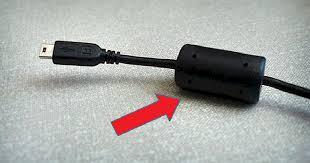
Charging Cable: Most people plug in their phone or laptop charger every day without giving it a second thought. The cable goes into the socket, the battery icon lights up, and life moves on. Along the length of many charging cables, however, there is a small black cylindrical component that often goes unnoticed. It does not blink, light up, or make any sound, yet it quietly performs a task that is essential for the safety, stability, and longevity of modern electronic devices.
This small component is far more important than it appears. It plays a silent but critical role every time electricity or data flows through the cable, ensuring that your devices work smoothly and remain protected from invisible electrical problems.
A ferrite bead, sometimes also referred to as a ferrite choke, is designed to manage electrical noise. When power or digital signals travel through a cable, they do not always move in a perfectly smooth manner. High-frequency interference can develop along the way, creating unwanted electrical signals that ride on top of the intended current.
These unwanted signals are a common byproduct of modern electronics. Wireless networks, nearby devices, power adapters, and even household appliances can introduce interference. A ferrite bead absorbs and suppresses this noise before it reaches sensitive internal components of your phone, laptop, or tablet. Instead of allowing harmful spikes to pass through, it converts that excess energy into a small amount of heat, keeping the signal clean and stable.
Unlike protective components such as fuses or circuit breakers, a ferrite bead does not stop the flow of electricity. Its job is not to cut power, but to refine it. Low-frequency signals, which are necessary for charging and data transfer, pass through almost unaffected. High-frequency noise, which can cause problems, is reduced or eliminated.
This selective filtering makes ferrite beads especially useful in charging cables and data cables. They act like a smooth traffic system for electrical signals, ensuring that only what is needed reaches the destination. The result is a stable connection that protects internal circuits from stress and disruption.
Without proper noise suppression, electronic devices can experience a wide range of issues. Charging may become inconsistent, batteries may heat up unnecessarily, and data connections can suffer from interruptions. Over time, repeated exposure to electrical interference can degrade components, reducing overall performance and shortening device lifespan.
Ferrite beads help prevent these problems by maintaining signal integrity. This means fewer charging interruptions, more reliable data transfers, and reduced risk of internal damage. While users may never directly notice the presence of a ferrite bead, they certainly benefit from the smoother performance it provides.
Modern devices are built with extremely compact and sensitive circuitry. Even minor electrical irregularities can cause long-term wear. By minimizing interference at the cable level, ferrite beads reduce the workload on internal regulators and protection systems. This contributes to better thermal management, fewer errors, and more consistent operation over time.
In a world where people rely heavily on electronics for communication, work, and entertainment, this tiny component plays a crucial supporting role. It ensures that devices remain dependable, even in environments filled with electrical noise.
The next time you notice that small black cylinder on your charging cable, it is worth recognizing its contribution. It does not demand attention, but it quietly safeguards your devices every time they are plugged in. From stable charging to reliable data transfer, the ferrite bead helps make modern technology feel effortless.
Often, the most important parts of technology are the ones we never think about. This small addition to a simple cable proves that even the tiniest components can make a significant difference in everyday digital life.