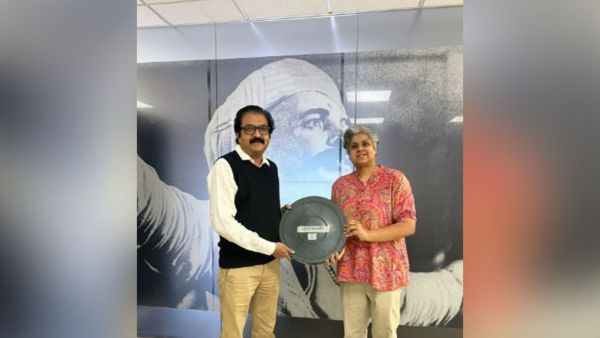
Tamil film Ratha Kanneer (1954) was added to the collection of the National Film Archive of India (NFAI) on Friday. The film was directed by the Krishnan-Panju duo and written by Thiruvarur Thangarasu.

Aparna Subramanian, Film Research Officer at Film and Television Institute of India (FTII), on Friday, donated a copy of film material, including 8 jumbo reels in 35mm format from her personal collection, to Prakash Magdum, the Managing Director of National Film Development Corporation (NFDC), in Pune, according to the Press Release by Ministry of Information & Broadcasting.
The film, featuring MR Radha in the lead role, was pathbreaking for its time and presented perspectives on issues such as caste discrimination, blind faith, and ritualistic practices. It also addressed social stigma around leprosy, depicting the protagonist's transformation from a wealthy, westernised philanderer to a leprosy patient abandoned by society.
As for MR Radha, the actor was a theatre legend who brought immense versatility to the role. His performance in the first half, as the sarcastic, westernised rich man, is both funny and chilling, while his transformation into a leper in the second half is described as meticulous and complete. His bent posture, unsynchronised body movements, and distinctive dialogue delivery became legendary, according to the press release by MIB.
This film promoted a revolutionary perspective on widow remarriage. In the film's climax, the hero, before his death, asks his wife if she would like to remarry his friend. Many cinemagoers and critics consider Madras Rajagopalan Radhakrishnan's (MR Radha) performance in Ratha Kanneer as one of the greatest in the actor's career.
NFDC Managing Director Prakash Magdum said that despite its immense cultural and historical significance, no film archive in India or internationally possesses a print or original negative of this historic 1954 film. The only versions available today are low-resolution copies circulating on online platforms. Therefore, acquiring this film is crucial for its long-term preservation and accessibility to the public. He appealed to film enthusiasts to come forward and donate films and other memorabilia for preservation at the NFAI, as per the press release by MIB.
Aparna Subramanian expressed her delight at donating a print of the film to the NFAI. She said that it truly belongs at the NFAI for preservation, archiving, and future restoration. She explained that she acquired the film from her old circle of film collectors and distributors in South India.
(Except for the headline, this story has not been edited by Asianet Newsable English staff and is published from a syndicated feed.)