Magh Mela 2026 : After Mahakumbh, Prayagraj has once again turned into a big spiritual centre, but the same enthusiasm and energy is still left in the city. The reason for this is the 45-day long Magh Mela, which starts from Paush Purnima (3 January) and continues till Mahashivratri (15 February). This Magh Mela becomes Kumbh Mela every four years and Mahakumbh Mela becomes Maha Kumbh Mela every 12 years.
If you are visiting Prayagraj this time for Magh Mela, your biggest attraction will definitely be taking a holy dip in the Triveni Sangam. But after completing the bath and puja, there is a lot more to explore in the city. It has peaceful gardens, old monuments from the Mughal era and places that evoke memories of India’s freedom struggle.
Read now on WhatsApp also, click to subscribe
This grand fort built on the banks of river Yamuna was built by Emperor Akbar in 1583. It is also called Akbar Fort and is considered to be the largest fort built during the Mughal period. Earlier its structure was very unique and magnificent, but nowadays it is under the control of the Indian Army, hence only a small part of it remains open for tourists. Some of the special things you can see inside the fort are: Jodhabai Mahal and Zenana (women’s section), Ashoka Pillar from the 3rd century BC, Saraswati Kupa – an old well from which the legendary Saraswati river is believed to flow. The most famous inside the fort is Akshayavat. A very old banyan tree which is considered immortal. According to legends, Lord Ram, Mother Sita and Lakshman rested in the shade of this tree during their exile. Some stories also have it that all attempts to burn or cut this tree were unsuccessful. This tree is still a major center of people’s faith.
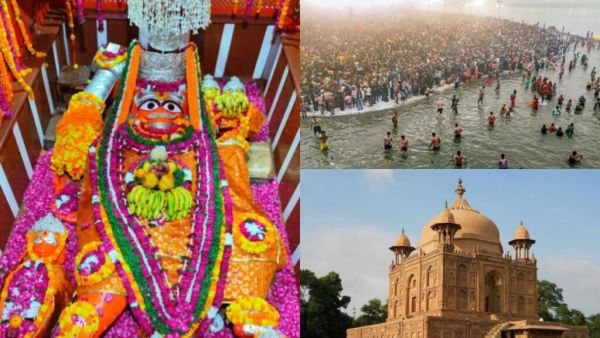
One of the most unique temples of Prayagraj is the temple of reclining Hanuman ji located near Sangam. It is also called Bade Hanumanji Temple. Here there is a very rare idol of Lord Hanuman lying down (in sleeping posture), which is considered to be Swayambhu (manifested by himself). Devotees believe that with time this idol gradually sinks into the ground and comes up again during the monsoon. This is believed to be to the flow of the river. This temple is full of faith and miracles. During the Magh Mela, especially on the main bathing days, there is a huge crowd here as people consider it necessary to have darshan here after taking bath in the Sangam.
This temple is a Shakti Peetha and is very special because there is no idol of the goddess here, only a swing (cradle) is kept. According to the legend, when the body parts of Mata Sati were cut into pieces, her right hand fell here and then disappeared. Since this was the last body part to disappear, the goddess is called Alopi Devi. This temple remains filled with devotees throughout the year and is even more vibrant during the Kumbh or Magh Mela.
Khusro Bagh is the most beautiful and popular tourist destination of the city. It is a large Mughal garden which contains the tombs of Emperor Jahangir’s family. Here are the tombs of Prince Khusro (elder son of Jahangir), his mother Sultan Begum and sister Nithar Begum. These tombs are very beautiful – they have intricate carvings and magnificent Mughal style architecture. These are counted among the finest Mughal monuments of India. Wandering here gives a feeling of both peace and history.
Spread over the Civil Lines area, earlier known as Alfred Park, this 133-acre large and lush green park is very peaceful. But its biggest identity is that on 27 February 1931, only 24 year old young revolutionary Chandra Shekhar Azad fought his last battle with the British here. He was martyred in the firing. This place still reminds of their sacrifice and is a very emotional place for the people associated with the freedom struggle.
This big and grand mansion was once the home of the Nehru family. Now it has been converted into a museum where photographs, documents, books and memorabilia to India’s freedom movement are kept. Nearby is Swaraj Bhawan, which was earlier the home of the Nehru family and later became the headquarters of the Congress Party. Anand Bhawan was built later for this reason. By visiting here you get a deep understanding of the country’s freedom struggle and the role of the Nehru-Gandhi family.
So if you are in Prayagraj, do not limit yourself to just bathing and worship. Be sure to visit these historical and spiritual places too – they reveal the true soul of the city.