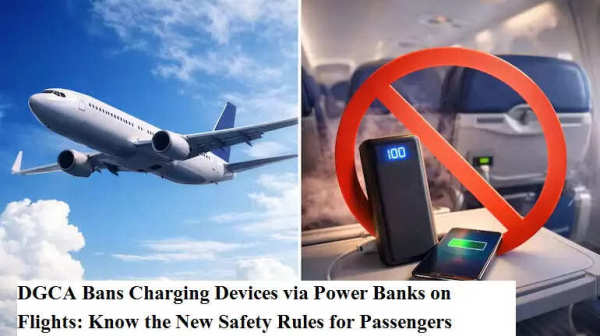
Air travel safety regulations in India have become stricter with the latest directive issued by the Directorate General of Civil Aviation (DGCA). According to the new rules, passengers are no longer allowed to charge their mobile phones, laptops, tablets, or any electronic gadgets using power banks during a flight. This restriction also applies to charging devices through aircraft seat power outlets when a power bank is used as the source.
The decision has been taken in response to rising global concerns over the safety risks posed by lithium-ion batteries, which are commonly used in power banks and portable chargers.
Lithium batteries are known to be sensitive to heat, pressure, and physical damage. Several incidents across the world have highlighted cases where power banks overheated mid-flight, resulting in smoke or even fire inside aircraft cabins. Such incidents pose serious threats to passenger safety and aircraft operations.
DGCA stated that even a small spark or battery malfunction can escalate rapidly at cruising altitude, making it difficult to control fire-related emergencies. To minimize these risks, the aviation regulator decided to prohibit the use of power banks for charging devices during flights.
While charging devices using power banks is now banned during flights, passengers are still permitted to carry power banks—but only in their hand baggage. DGCA had earlier clarified in its Dangerous Goods Advisory Circular that power banks and spare lithium batteries must never be placed in checked-in luggage.
In addition, these devices should not be stored in overhead cabin compartments. Instead, passengers are advised to keep them under the seat in front, where any abnormal heating, smoke, or fire can be detected immediately.
According to aviation safety experts, overhead storage bins are particularly dangerous locations for lithium battery fires. When power banks are stored in overhead compartments, they remain out of sight of both passengers and cabin crew. This delay in detection can result in rapid fire spread before any corrective action is taken.
DGCA emphasized that visibility plays a crucial role in emergency response. Keeping such devices within visible range allows cabin crew to act swiftly in case of overheating or smoke.
The aviation regulator has instructed all airlines operating in India to reassess the risks associated with lithium batteries carried by passengers. Airlines have been advised to implement additional safeguards to prevent battery-related fire incidents onboard.
This includes revising internal safety protocols, monitoring passenger compliance, and ensuring that prohibited charging activities do not take place during flights.
DGCA has also placed strong emphasis on crew preparedness. Airlines have been directed to enhance training programs for cabin crew, focusing on early identification of battery-related hazards and correct firefighting procedures.
Moreover, airlines must ensure that fire suppression equipment, protective gloves, and emergency kits are always readily available inside the aircraft.
To avoid confusion or inconvenience, DGCA has asked airlines to inform passengers clearly about the new rules through pre-flight announcements, safety briefings, and onboard notices. Travelers are advised to charge their devices fully before boarding and use in-flight entertainment systems or seat charging ports directly for permitted devices.
With air traffic steadily increasing, authorities believe that these preventive steps are essential to ensure passenger safety and reduce the risk of onboard emergencies caused by battery malfunctions.