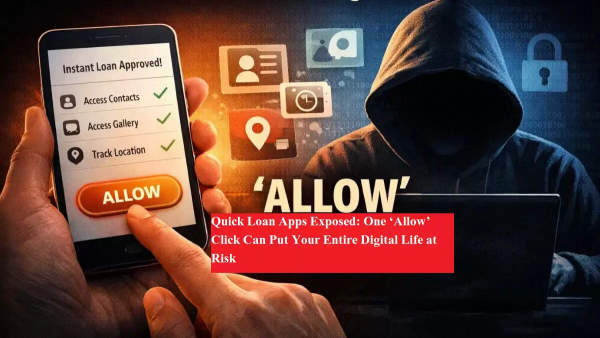
In today’s fast-paced digital world, financial stress has become one of the easiest tools for cyber fraudsters to exploit. Taking advantage of urgent money needs, several quick loan mobile apps promise instant approval, zero paperwork, and fast disbursal within minutes. While these offers may seem like a lifeline during emergencies, the real danger often hides behind a single tap on the “Allow” permission button.
Most users focus only on whether they receive the loan or repay it on time. However, experts warn that the bigger threat is not the loan amount but the personal data access these apps demand.
When users install instant loan apps, they are often asked to grant permissions for contacts, photo gallery, files, location, device information, and sometimes even call logs. Since the interface appears smooth and professional, many users treat these permissions as routine formalities and approve them without reading.
The loan may be repaid within weeks or months, but your data doesn’t automatically return. Once shared, it may remain stored on the app’s servers, long after the financial obligation ends.
Traditional banks and RBI-regulated NBFCs evaluate borrowers using identity documents, income proof, credit history, and bank statements. They do not require access to your contacts or personal photos.
Some instant loan apps claim they use “alternative credit assessment,” meaning they analyze user behavior, phone usage patterns, and digital activity. While this may sound innovative, the real concern lies in how this data is later used, especially if there is a delay in repayment.
Among all permissions, contacts access is the most dangerous red flag. This doesn’t just give apps phone numbers—it reveals your entire social circle, including family members, colleagues, doctors, school groups, and clients.
In worst-case scenarios, if a borrower misses an EMI, recovery agents may misuse contact lists for harassment, public shaming, or repeated calls and messages. Despite regulations, enforcement remains inconsistent across platforms.
A simple question every user should ask:
Why does a lender need to know whom I know?
Many apps claim gallery access is required for uploading documents. While document upload is reasonable, there is a critical difference between selecting one file and giving full gallery access.
Your phone gallery may contain sensitive material such as:
Aadhaar and PAN images
Bank message screenshots
Medical records
Private conversations
Office documents
If an app demands unrestricted access to your entire gallery, it’s safer to pause and reconsider. Modern operating systems allow selective uploads—users should always choose that option if available.
Location access can reveal where you live, work, and travel regularly. Device permissions allow apps to analyze how frequently you use your phone and which apps you interact with.
Though often justified under “fraud prevention,” this data can also be used for profiling, targeted marketing, or misuse if leaked.
Yes, permissions can be disabled from phone settings. But this only stops future access. Any data already uploaded to servers cannot be undone. That makes the moment you first tap “Allow” the most critical decision point.
Verify the lender: Is the loan provided by an RBI-regulated bank or NBFC?
Read the privacy policy: What data is collected, why, and for how long?
Check upload options: Does the app allow single-file uploads or demand full access?
Customer support availability: Is there a real grievance redressal system?
If a permission request seems unrelated to lending—especially contacts and full gallery access—stop immediately. A loan may be necessary, but no lender needs the keys to your entire digital life.
Your strongest protection is not after the damage is done, but at the exact moment you are about to tap “Allow.”