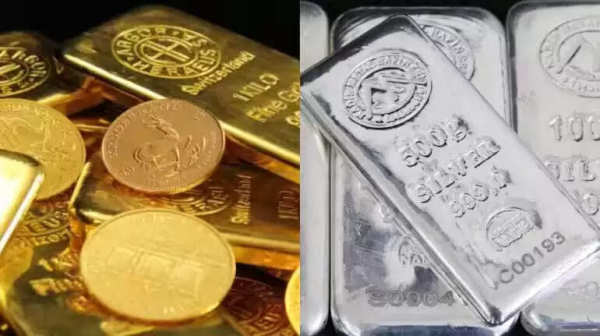
Gold and silver prices witnessed a sharp rise on January 6, driven by growing geopolitical tensions and renewed demand for safe-haven assets. The rally pushed gold prices to a one-week high in the international market, while domestic prices in India also moved higher across spot and futures segments. With bullion prices gaining momentum once again, investors are now confused about whether this is the right time to buy, sell, or hold gold and silver.
In the international market, spot gold climbed nearly 0.5 percent to $4,496.96 per ounce. A day earlier, on January 5, gold had surged by almost 3 percent, highlighting strong buying interest. It is worth noting that gold had touched an all-time high of $4,549.71 per ounce on December 26, reflecting the metal’s strong long-term trend.
Gold has emerged as one of the best-performing assets in recent times. During 2025, gold delivered an impressive 64 percent return, making it a preferred investment choice amid global uncertainty, inflation concerns, and volatile equity markets.
Market experts point to escalating geopolitical risks as the primary driver behind the current rally. The recent developments involving the United States and Venezuela have increased fears of political instability in South America. The US President has stated that the United States will maintain control over Venezuela for the time being, which has unsettled global markets.
Earlier, expectations of a possible reconciliation between Russia and Ukraine had slightly softened gold prices. However, fresh geopolitical developments have once again revived risk aversion, pushing investors towards bullion, especially gold.
Apart from geopolitical factors, investors are closely tracking key economic data from the United States. Important indicators such as employment figures, jobless claims, and non-farm payroll data for December are scheduled for release this week. These numbers are expected to provide clarity on the future stance of the US Federal Reserve.
If the Federal Reserve signals or initiates interest rate cuts, gold prices could receive further support, as lower interest rates typically make non-yielding assets like gold more attractive. The Federal Reserve’s policy announcement later this month will be crucial for bullion markets.
The uptrend was clearly visible in the Indian market as well. On January 6, 24-carat gold was priced at ₹13,621 per gram, while 22-carat gold stood at ₹12,486 per gram. Silver prices also moved higher, trading at around ₹2.42 lakh per kilogram in the spot market.
On the Multi Commodity Exchange (MCX), gold futures were trading at ₹1,38,542 per 10 grams, up by ₹422 or 0.31 percent at around 1:20 PM. Silver futures witnessed an even stronger move, rising by ₹4,075 or 1.66 percent to ₹2,50,230 per kilogram.
According to Soumil Gandhi, Senior Analyst (Commodities) at HDFC Securities, the rise in gold and silver prices is directly linked to increasing geopolitical risks. He noted that demand for safe-haven assets has surged following US action against Venezuela. Additionally, recent statements related to Colombia and Mexico have raised concerns about broader regional instability in Latin America, further supporting bullion prices.
Experts believe that the overall outlook for gold and silver remains strong in the near term. Rising geopolitical tensions and uncertainty around global economic growth continue to favor precious metals. However, after the recent sharp rally, fresh buying at elevated levels may not be ideal.
Market analysts suggest that existing investors should hold their gold positions, as prices could remain firm. Those planning to invest in gold or silver should wait for a price correction before entering. From a portfolio perspective, maintaining an allocation of 5 to 10 percent in gold and silver is considered a balanced strategy to manage risk and volatility.