For decades, there has been a common Hollywood theme that future wars would consist of robotic vehicles being zapped from the skies by potent energy beams. This scenario seems to be getting closer by the day. The war between Russia and Ukraine has changed the face of warfare, with unmanned drones now used extensively on the battlefield. This is something that has left traditional defenses floundering to keep up as swarms of mass-produced drones create unprecedented challenges.
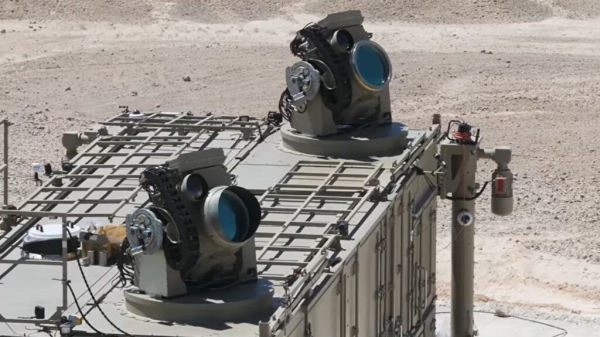
This is the demanding environment that Israel’s Iron Beam laser is designed for. Developed by Rafael Advanced Defense Systems, it went into operation with the Israeli Defense Force at the end of 2025. The weapon is designed to operate against shorter-range weapons such as the aforementioned drones, but also against rockets and even mortar shells. At the heart of the system is a 100-kilowatt laser beam that can intercept and destroy threats like drones and smaller rockets. During a ceremony at Rafael’s headquarters, Israeli Defense Minister Israel Katz said the system “changes the rules of engagement” with Major General Amir Baram, adding that it would “dramatically improve both our capability against complex threats and the cost-effectiveness equation between interception and threat.” Israel had previously relied on expensive missile interception systems to defend against these threats.
For comparison, interceptor missiles can cost up to $100,000 per launch, with the new Iron Beam system costing just a few cents of electricity. Additionally, as long as you have power, you have ammunition. The system is not designed to replace the country’s existing Iron Dome defence system; rather, it will be used to free up missile systems to focus on larger threats.
What we know about Israel’s Iron Beam
The Iron Beam laser system has been in development since 2014 and has already been successfully tested in real combat situations, when it intercepted incoming threats fired from Lebanon. Katz also noted that it’s the first weapon of its type to have reached “operational maturity,” and that its handover was a “historic occasion.”
The major difference between the Iron Beam system and traditional air defense systems is the use of directed energy beams rather than physical ammunition. The core of the system is a high-energy laser in the 100-kilowatt class. The system focuses this powerful laser onto a target, long enough for the target to heat up to the point that critical components fail, or by activating the fuse and detonating the warhead. While Rafael is the named contractor behind the project, the laser technology was provided by Elbit, an Israeli defence manufacturer with 40 years of experience in the field.
The weapon is designed to protect against short-range, low-altitude targets such as small drones, mortars, and short-range rockets — the type of inexpensive threats that are increasingly deployed in large numbers. A point that grows in relevance when you consider that future generations of drones could be as small as mosquitoes. Iron Beam has a range of six miles or 10 kilometers. However, its effectiveness is greatly reduced by adverse weather, dust, or smoke, limiting how and when the system can be used.
Are we entering the age of the laser weapon?
The Israelis are far from being the only country pursuing the technology. In the UK, for instance, a government contract worth $428 million has been awarded to develop the DragonFire laser, a prototype of which successfully shot down drones. It’s worth pointing out that these drones were flying at twice the speed of a Formula One race car.
Australia is another country with an advanced laser weapon program. The country’s Apollo system, developed by Electro Optic Systems, is capable of shooting down up to an incredible 20 drones per minute at a cost of about $1 per shot. The weapon has already been sold to the Netherlands. The US is also working on such systems, and two prototypes of a 20-kilowatt mobile system were delivered last year. The LOCUST counter-drone laser is designed to be integrated onto Infantry Squad Vehicles to protect against battlefield drone threats.
What links all these systems is the changing nature of the aerial threat. Small drones are cheap, expendable, and increasingly deployed in large numbers. Against this, traditional systems may successfully repel attacks, but at a cost. For instance, in Israel’s case, a large part of a US-allocated missile defense budget was spent replacing Tamir interceptors at a cost of $50,000 a pop. The economics of this aren’t sustainable, and by dropping the cost from potentially millions of dollars for a single Patriot launch to a few dollars, the rise of the battlefield laser is inevitable.