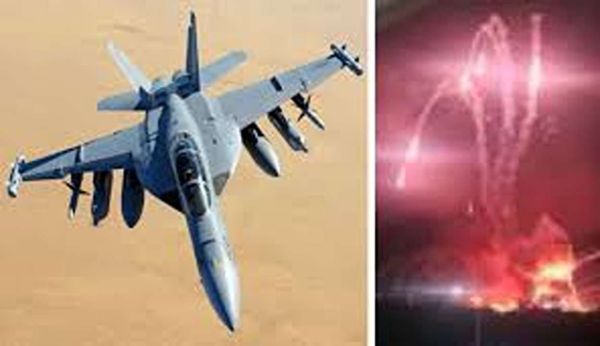
During Maduro: According to a media source, US Navy electronic-warfare planes known as EA-18G Growlers were crucial in blinding Venezuela’s air defenses during the military operation that resulted in President Nicolas Maduro’s detention.
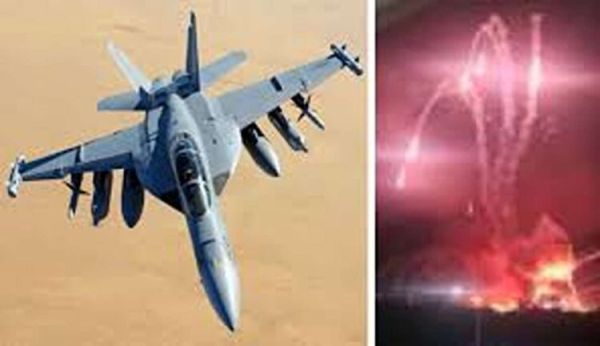
The Wall Street Journal emphasized Washington’s increasing dependence on signal-jamming technologies in contemporary combat in a significant defense report on Boeing’s Growlers.
The Growler is a carrier-based electronic assault plane that is intended to dominate the electromagnetic spectrum rather than drop bombs. It was a part of a sizable US air force that silenced communications and radar systems during the Venezuela operation, enabling special operations aircraft to swiftly enter and leave Venezuelan airspace.
According to the source, the operation encompassed over 150 US aircraft, including drones, fighter fighters, and bombers. However, the Daily noted that the Growler was unique in that it targeted communications rather than ground-based targets.
According to experts in electronic warfare, this is the reason the aircraft is so successful. In order to confuse or overload the system, jamming pods installed aboard the Growler listen for and analyze adversary radar transmissions in real time. In reality, this may result in radar displays losing track of actual airplanes or filling with fictitious targets.
In US Navy service, the EA-18G superseded the previous EA-6B Prowler and is based on Boeing’s F/A-18F Super Hornet. It became the mainstay of US airborne electronic warfare after going into active duty in 2009. The aircraft is also operated by Australia.
According to military specialists quoted in the study, Growlers were able to circumvent Venezuela’s deteriorating air defense system, which mostly depends on outdated Soviet and Russian-made equipment, including S-300 missile systems. Although they are mostly older types, Venezuela also uses several Chinese radar systems.
The experts did warn, however, that such strategies would be more challenging against a near-peer enemy like China or Russia, which have more sophisticated and robust air defense systems. However, the operation in Venezuela demonstrated how, after years of relative neglect, electronic warfare has acquired prominence again.
There was less need for intensive jamming during wars in Afghanistan and the Middle East because US troops encountered less advanced air defenses. The war in Ukraine, which is now regarded as the biggest electronic warfare battle in history, altered that.
Additionally, contemporary jamming pods are changing. Digital, software-driven pods that can rapidly adjust to new threats and swap frequencies in milliseconds are replacing older analog systems like the ALQ-99. These devices have the ability to interfere with communications, jam radars, or produce false signals that trick adversary sensors.
According to specialists, aerial jamming is still crucial despite US rivals’ advancements. Control of the electromagnetic spectrum is predicted to be just as important in future battles, particularly in the Indo-Pacific, as airplanes or missiles.
Electronic warfare may not be as obvious as fighter aircraft or ships, but it is “critically important” in determining who controls the sky, a former US defense official told the Journal.