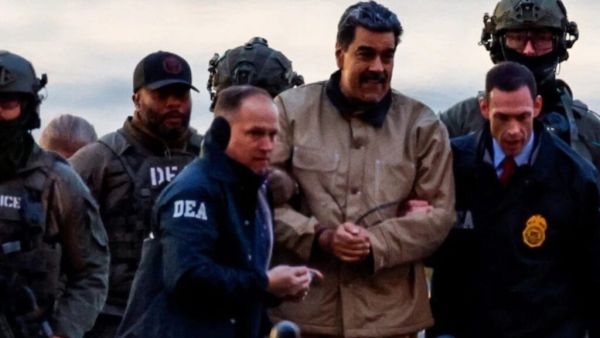
After the arrest of Venezuelan President Maduro, America’s military action is once again at the center of global discussion. This secret operation ‘Operation Absolute Resolve (#OAR’), carried out under the leadership of President Donald Trump, not only shook international politics, but has also sparked a new debate on the role of the media.
A joint operation by US Army Delta Force, #CIA, Navy and #FBI led to a massive military operation in Venezuela and ultimately arrested Maduro and his wife and brought them to New York. But even more important than this entire incident is the fact which later came to light that the American media was already aware of this operation, yet it deliberately did not make it public. This is the point which has given an opportunity for introspection for the Indian media today.
Restraint of the American media and national interest – It has now become clear that the senior editors of prestigious American newspapers like ‘New York Times’ and ‘The Washington Post’ were already given sensitive information about this secret military action by their sources. Despite this he did not publish it. The reason was simple and clear: the safety and national interest of American soldiers. This decision was taken at a time when the conflict between President Trump and the American media has been well known. Despite ideological opposition, political disagreements and sharp criticism, the American media appeared united when it came to the safety of the country and the lives of its soldiers.
This reflects the longstanding tradition of American journalism in which restraint and responsibility are placed above freedom of expression in matters to national security. Here it is important to understand that even in America, the press is free, critical and asks questions to those in power, but it also knows that exposing every truth all the time is not journalism. Sometimes silence is also a form of patriotism.
Situation in comparison to Indian media: On the contrary, if we look at the behavior of Indian media, the picture appears somewhat different. Many times such a competition has been seen here that what should not be shown is tried to be shown first. Even in matters to national security, military operations and terrorism, the competition between ‘exclusive’ and ‘breaking news’ often outweighs discretion, or it can be said that it is still outweighing discretion. In this context, it is mentioned that the recently released film ‘Dhurandhar’ has once again brought the role of media in discussion during the 26/11 Mumbai terror attacks. From the night of 26 November 2008 to 29 November, several TV channels continuously showed live footage from Hotel Taj, Oberoi and other locations. These broadcasts alerted terrorists and harmed the strategy of security forces. The result was that many soldiers had to make the supreme sacrifice. Later serious questions were raised on this, but by then it was too late. What we as a country India should not have lost. We had lost him in the form of our soldiers and people.
This is not an isolated example. Be it the Kargil war, the ongoing operations in Kashmir or other sensitive security issues, the Indian media has been repeatedly accused of ignoring long-term national interests in the name of immediate expression. Freedom of expression versus national interest – The basic question here is not whether the media should be independent or not, undoubtedly it should be independent and it is. The question is, what should be the limits of freedom? Can the right to expression be above national interest? The American example makes clear that the answer is ‘no’. The media there did not say that ‘the public has the right to know’ but rather believed that if this information threatened the lives of American soldiers then it should be withheld.