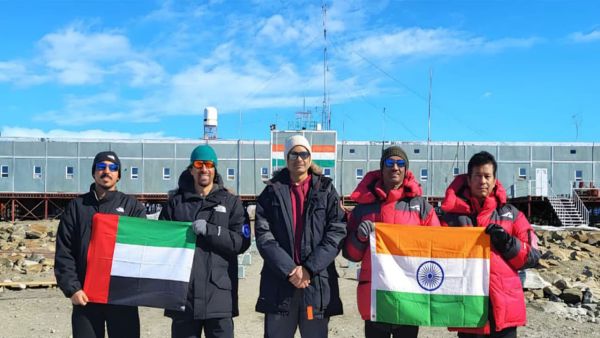
India and the United Arab Emirates have taken their growing scientific partnership to Antarctica, with Emirati researchers from Khalifa University joining India's 45th Antarctic Expedition at the Maitri research station, said the Indian embassy in the UAE.

The joint team is studying Antarctica's extreme, Mars-like landscapes to support research in polar science and planetary studies. The collaboration reflects deeper cooperation between the two countries in climate research, earth sciences and space-linked studies. "Emirati researchers from Khalifa University joined India's 45th Antarctic Expedition at Maitri station, exploring Antarctica's Mars-like landscapes to advance polar & planetary science, " the Embassy wrote in an X post. https://x.com/IndembAbuDhabi/status/2008784222761488868/photo/2
The participation of UAE scientists follows a key agreement signed between India and the UAE to strengthen cooperation in polar research. On December 13, 2024, the United Arab Emirates and India signed a Memorandum of Understanding (MoU) to enhance collaboration in polar and ocean research.
The MoU was signed between the Emirates Polar Program and India's National Centre for Polar and Ocean Research (NCPOR) during the 15th session of the UAE-India Joint Committee Meeting. The agreement was signed by Abdulla Balalaa, Assistant Minister for Energy and Sustainable Affairs and Deputy Chair of the UAE Polar Mission Steering Committee, and M Ravichandran, Secretary, Ministry of Earth Sciences (MoES), Government of India, according to the UAE Ministry of Foreign Affairs.
The partnership aims to support joint scientific missions in Antarctica and the Arctic, encourage data sharing, and promote research related to climate change, polar ecosystems and earth system science.
The Emirates Polar Program, launched to strengthen the UAE's presence in polar science, focuses on participating in international polar missions and contributing to global climate action. Through collaboration with India, the UAE seeks to deepen its understanding of polar environments while reinforcing international scientific cooperation.
(Except for the headline, this story has not been edited by Asianet Newsable English staff and is published from a syndicated feed.)