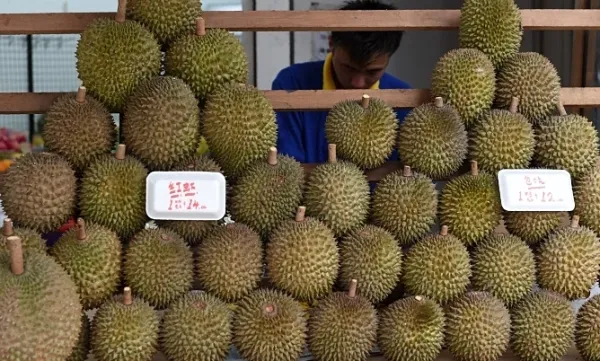
Following a recent price crash due to oversupply across the border, sellers in the city-state have been pricing the durian, also known locally as Mao Shan Wang, as low as S$8 (US$6.25) per kilogram.
“Compared to the previous season, it’s about S$8 cheaper per kilogram,” Anthony Gan, who owns the Famous Durian stall in Yishun, told Channel News Asia.
The rates are the lowest he has ever seen in his 10 years in the trade, he added.
At Durian Empire in Punggol Plaza, the fruit fetches S$8-18 per kg, nearly half the previous average rate of S$15-24.
The steep decline follows an unusually bumper harvest in Malaysia, the main supplier of durians to Singapore.
New Straits Times earlier reported that Musang King, once regarded as a premium variety, had fallen to RM10 (US$2.4) per kg at farms across Malaysia and dipped even further in some areas due to the glut.
Other popular cultivars, such as Black Thorn, D24 and IOI, also became cheaper there.
|
Durians are seen for sale in Singapore’s Little India district on July 25, 2016. Photo by AFP |
Singaporeans love the pungent fruit and particularly favor Musang King for its creamy texture and bittersweet taste.
The city-state sources about 85% of its durians from its neighbor in the north and imports around 100,000kg of the fruit per day during the peak season, according to Bloomberg.
Hence, lower prices have translated into a spike in demand. Derrick Ooi, owner of 211 House of Durian in Lorong 8 Toa Payoh, told The Straits Times that his December sales jumped 30-40% from earlier months. Zen Ho, who runs Durian Empire, reported a 20% jump from previous years.
Famous Durian’s Gan said his daily orders have exceeded 100 since last November, compared to 60-70 before that.
Alvin Teo, owner of Durian 36 in Geylang, said he imports around 700-800kg of Musang King durians daily, up 20% from 2024, but still manages to sell most of them. He also saw a 50% increase in online delivery sales this season.
However, sellers caution that the price relief is likely to be short-lived as supplies are expected to tighten toward the end of the durian season later this month and into February.
“Most probably, I think, can last for another two weeks’ time,” Teo said, adding that a 20-30% price increase might follow.
Though prices may fluctuate, the fruit would remain available through the Lunar New Year, according to 211 House of Durian’s Ooi.