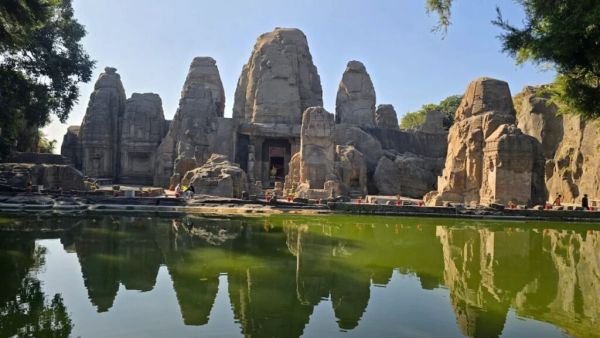
Masroor Rock Cut Temple, located in Kangra district of Himachal Pradesh, is famous throughout the country due to its unique craftsmanship, ancient history and religious beliefs. This temple group, built by cutting a single huge rock, is considered a rare example of rock-cut architecture not only in Himachal but in the entire country. This temple complex, built around the eighth century, is also called the ‘Ellora of Himachal’, which even today attracts people interested in history, faith and art.
There are about 15 temples carved out of a single stone in the Masrur temple complex, which clearly reflect the Nagara style. The carvings of the temple, the pavilions, the shikhara and the sanctum sanctorum are all carved out of rock. Some part of the temple was damaged by the severe earthquake of 1905, but despite this, its architectural grandeur is still clearly visible.
The Masroor Rock Cut Temples are a group of temples carved out of a single massive rock in the early 8th century. It is also called the ‘Ellora of Himachal’, as its structure and carvings are reminiscent of similar world famous rock-cut temples.
Here a total of about 15 small and big temples have been built from the same stone, whose foundation, peak and pavilion are all cut out of rock. Extremely detailed and intricate carvings of gods, goddesses and mythological stories are visible inside and outside the temples. The entire complex of temples is arranged according to a square grid.
The Masrur temple complex is believed to have been built around the 8th century. It is an excellent example of North Indian urban style architecture.
The 1905 earthquake damaged many parts, so the temples today appear to be in somewhat ruins archaeologically, but many structures are still in good condition.
Earlier the existence and construction on this site was planned to be even bigger but due to earthquakes and time, research is ongoing on why many parts of it are still incomplete.
According to local belief, the Pandavas of Mahabharata had started the construction of this temple during their exile but due to some reason it had to be left incomplete. A pond built in the temple complex, which is associated with Draupadi.
A folk tale states that a staircase built within the complex was being built as a way to heaven, but was stopped before completion because the gods prevented it. There is no written evidence of these stories, yet local people still believe in them.
By Road:
nearest airport
Nearest Railway Station