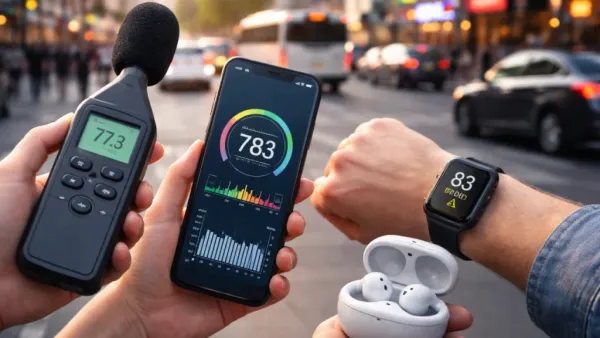
If you live in a city, silence feels rare. Morning starts with traffic. Evenings end with horns, bikes, buses, and loud streets. For many people, this has become normal life. Noise is just there, all the time. But the body does not adjust the way the mind does.
Doctors and health groups have been warning for years that constant noise slowly harms hearing and mental health. The issue is not one loud sound. The issue is daily exposure that keeps adding up.
Noise pollution trackers try to solve one simple problem. They help people understand how loud their surroundings actually are.
Noise pollution trackers measure sound in decibels. Decibels can be found in many areas, such as medical studies or daily safety regulations regarding noise at work. As the number of decibels increases, so does the intensity of the sound.
Typically, a quiet sleeping environment has a level of 40 decibels or less. Normal talking is close to 60. Busy city traffic often crosses 85. Construction machines and loud events can easily go beyond 100.
According to NIOSH, which works on workplace safety in the US, long exposure to above 85 decibels increases the risk of hearing damage. At higher levels, even short exposure can be harmful. Noise trackers exist to show when these limits are crossed without us realizing it.
Noise damage is slow and quiet. People expect pain or discomfort when something is harmful. Noise usually does not work that way. You can sit in a noisy place for years and feel fine, until one day you don’t. Medical research shows that loud sounds damage tiny cells inside the ear. These cells do not grow back. Once they are damaged, hearing loss becomes permanent.
WHO has also linked long-term environmental noise to sleep problems, stress, and a higher risk of heart issues. Excessive noise at night can disrupt the quality of sleep without completely waking anyone from their slumber. Awareness of noise level is, therefore, more important than reaction to an event.
Sound level meters are proper hardware tools. Engineers, safety professionals, and City Department personnel use these devices as a means to both monitor noise levels and create accurate reports. The devices are calibrated at the time of purchase, therefore allowing them to read back, on multiple days or hours, the same set of measurements. Due to their reliability, the information collected is utilized for reporting purposes when creating reports or during inspections.

One drawback to the system is the cost and overall size of the device(s). The devices cannot be used for casual tracking of noise levels daily, as they are intended for professional or workplace- measurements.
Noise dosimeters are worn by workers. They measure how much noise a person is exposed to during a full workday. OSHA uses this kind of data to decide when hearing protection is required. You will mostly see these devices in factories, airports, and construction sites. They are important for worker safety but are rarely used by regular city residents.
Apple Watch changed how people think about noise. The watch checks the surrounding sound levels in the background. Loud noises for an extended period are associated with an audible and visual warning from Apple.
Therefore, although Apple has advised consumers that the above noise-monitoring feature is not meant to provide any type of clinical or real-time reading (such as using professional testing equipment), information gathered from noise monitoring will still be accurately provided to the consumer. Individuals who are constantly navigating in crowded or busy locations will find value in this gently supportive type of alert.
Some Fitbit and Samsung Galaxy watches also track environmental noise. These features are simpler and sample noise instead of tracking it all the time. How accurately an individual hears sounds can differ based on the microphone or recording system used; however, the majority of decibels will provide a general idea of the levels of sound an individual is likely to encounter in their daily lives.
Phone apps use the phone’s microphone. This microphone was made for calls, not scientific measurement. Because of that, accuracy can change from one phone to another. Still, studies comparing apps with professional meters show that good apps stay close enough for general awareness. That makes them useful for everyday use.
The NIOSH app is often mentioned because it was tested properly. It shows live sound levels and also calculates exposure over time. Many safety professionals use it when they do not have hardware meters. It is not perfect, but it is one of the better phone-based options.
Decibel X focuses on simplicity. It shows sound levels clearly and uses graphs that normal users can understand. It is popular among commuters and home users who just want to know if a place is too loud. For daily awareness, this kind of app does the job.
Noise-canceling earbuds work in two ways. Passive reduction comes from the ear tips that block sound physically. Active noise cancellation uses microphones to detect outside noise and create opposite sound waves.

This works best for steady sounds like engines and traffic. Sudden noises are harder to cancel. These earbuds do not track noise exposure, but they reduce how much noise reaches the ear. That still helps in the long run.
Noise tracking is now part of city planning. Cities like Paris and New York use fixed sensors to measure traffic and nighttime noise. This data helps them change road design, speed limits, and construction timing.
Crowd-based apps add another layer. They show noise at street level, near homes, schools, and hospitals. Urban noise monitoring is slowly being treated like air pollution monitoring.
Tracking alone does not help if behavior does not change. Small choices matter. Long duration of Travel: The use of Noise cancellation technology, lowering Headphone Volume, avoiding Loud environments for Long Times, and Quiet Rest Periods (Recharge).
Experts will Recommend Keeping Headphone Volume Low and Taking Short Breaks Between Listening Sessions. Although these habits seem very Standard, the practice over the Years can help Protect The Ability to hear.
There is no single best noise tracker. Apps and watches work for daily awareness. Professional devices are needed for inspections and research. The purpose is not perfect accuracy. The purpose is to know when noise becomes a problem.

Even though the prevalence of noise pollution may become commonplace, that does not mean that noise pollution is harmless. Noise pollution mapping gives individuals a way to observe and quantify the noise levels that they may have previously overlooked. They turn background sound into something visible. In cities that keep getting louder, this kind of awareness is not extra. It is necessary.