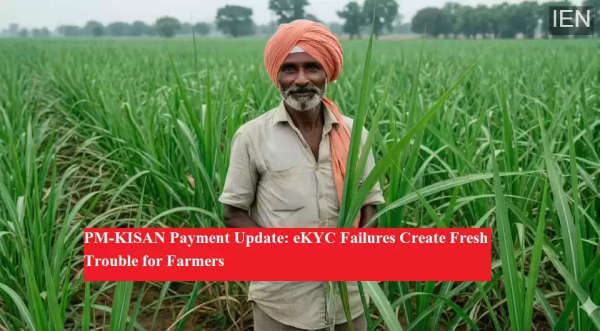
The PM-KISAN Samman Nidhi scheme was launched to provide direct financial support to farmers across India. However, recent reports suggest that technical requirements such as eKYC verification, Aadhaar seeding, and land record validation have turned into major hurdles for millions of eligible farmers. Instead of ensuring smooth and transparent payments, these digital checks are now delaying or blocking instalments, especially in rural areas.
The government made eKYC mandatory to eliminate fake beneficiaries and ensure that financial aid reaches genuine farmers. On paper, this decision appears logical and necessary. But the reality in villages tells a different story.
Poor internet connectivity, lack of digital awareness, and dependence on biometric machines have made the process complicated. Many elderly farmers, whose fingerprints have faded due to years of hard labour, fail biometric authentication. As a result, the system marks them as “verification incomplete” or “ineligible,” even though they fully qualify for the scheme.
Facial authentication apps, introduced as an alternative, are also proving unreliable. Low-light conditions, basic smartphone cameras, and frequent server issues prevent successful verification. Farmers are forced to make repeated visits to CSC centres and government offices, losing both time and money.
The problems do not end with biometrics. Even a minor mismatch between the name mentioned on the PM-KISAN portal and the Aadhaar card—such as spelling differences or initials—can stop payments entirely. While officials call it a “data mismatch,” for farmers it means months without instalments.
Another major issue is land seeding, which requires digital verification of land ownership records. In many states, land records are outdated or contain clerical errors. Farmers are being asked to prove ownership of land they have cultivated for decades. This has pushed them into a cycle of visits between patwaris, revenue offices, and agriculture departments.
According to various field reports, a significant number of farmers have been removed from the PM-KISAN beneficiary list in recent instalments. The government describes this as a “data cleansing exercise,” but social organisations argue that many genuine and needy farmers have been excluded in the process.
Data indicates that lakhs of farmers attempted eKYC multiple times. Some even paid fees at CSC centres, yet their status still shows “eKYC pending” weeks later. The lack of clarity and delayed updates have increased anxiety among farmers who depend on this money for seeds, fertilisers, and household expenses.
This situation raises an important question: is government assistance a right or merely a facility? Article 21 of the Indian Constitution guarantees the right to live with dignity. When welfare schemes become so technology-driven that beneficiaries struggle to access them, the purpose of such schemes comes into question.
Experts believe technology should act as a tool, not a barrier. If system failures prevent poor farmers from receiving their rightful benefits, the responsibility should lie with the administration—not the farmer. A robust grievance redressal system and offline alternatives are urgently needed.
To ensure PM-KISAN reaches its intended beneficiaries, experts suggest:
Allowing temporary manual verification where eKYC fails
Improving server capacity and rural internet connectivity
Simplifying name correction and land record updates
Making CSC services free for such essential schemes
PM-KISAN is a lifeline for millions of farmers, but technical hurdles are weakening its impact. Unless digital systems are made farmer-friendly and flexible, the gap between policy intent and ground reality will continue to grow. Technology should empower farmers—not decide their eligibility.