New Delhi: India Friday rejected as “inaccurate” US Commerce Secretary Howard Lutnick’s remarks that a proposed trade deal between the two countries couldn’t be sealed last year, as Prime Minister Narendra Modi did not make a telephone call to President Donald Trump.
New Delhi also asserted that it remained interested in concluding a “mutually beneficial” trade deal between the two “complementary economies” and noted that Modi and Trump held phone conversations on eight occasions in 2025, covering different aspects of ties.
Negotiations for a bilateral trade agreement between the two sides hit a major roadblock after Trump slapped a whopping 50 per cent tariff on India, including a 25 per cent additional duty for its purchase of Russian crude oil.
Lutnick told a podcast that India had been given “three Fridays” to seal the trade agreement, and that Modi had to call Trump to close it.
The fresh row between the two sides came as their relations passed through possibly the worst phase in the last two decades.
In his controversial comments in an interview Thursday, Lutnick detailed how the India-US trade deal has not happened till now.
The decision to negotiate the trade deal was taken at a meeting between PM Modi and President Trump at the White House February 13.
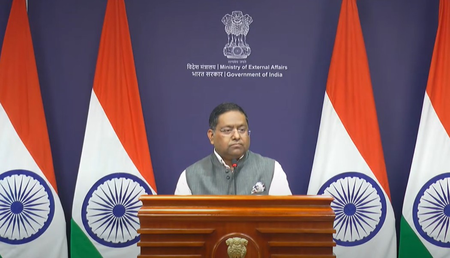
“We have seen the remarks. India and the US were committed to negotiating a bilateral trade agreement with the US as far back as February 13 last year,” External Affairs Ministry Spokesperson Randhir Jaiswal said.
“Since then, the two sides have held multiple rounds of negotiation to arrive at a balanced and mutually beneficial trade agreement,” he said at his weekly media briefing.
The MEA spokesperson also said, “On several occasions, we have been close to a deal. The characterisation of these discussions in the reported remarks is not accurate.”
Jaiswal said India remained interested in a mutually beneficial trade deal between two complementary economies, and it is looking forward to concluding it.
“Incidentally, the prime minister and President Trump have also spoken on the phone on eight occasions during 2025, covering different aspects of our wide-ranging partnership,” he said.
People familiar with the matter said no occasion had come in the course of last year when one single phone call could have helped seal the trade pact.
In his comments, Lutnick said India and the US were pretty close to firming up the trade pact, as he elaborated on negotiations for a similar deal with the UK.
He recalled that after the UK deal, everyone asked Trump which country would be the next, and the president talked about several countries, but he named “India a couple of times publicly”.
“We were talking (with) India, and we told India, ‘You have three Fridays’. Well, they have to get it done,” he said.
Lutnick said Trump does trade deals like a staircase — ” the first stair gets the best deal” — and the president had named India as being next in line after the US sealed a trade deal with the UK in June 2025.
“We did this whole bunch of deals because we negotiated them and assumed India was going to be done before them. I had negotiated them at a higher rate, so now the problem is the deals came out at a higher rate and then India calls back and says, ‘Okay, we’re ready’,” Lutnick said.
“I said ready for what? It was like three weeks later. Are you ready for the train that left the station three weeks ago?” he said.
“But let’s be clear; it’s his (Trump) deal. He is closer. He does the deal. So I said, ‘You got to have Modi, it’s all set up, you have to have Modi call the president. They (India) were uncomfortable doing it, so Modi didn’t call.”
Lutnick said after that Friday, the US announced trade deals with Indonesia, the Philippines and Vietnam. The US had firmed up a number of trade pacts with several countries in July.
The US commerce secretary suggested that the deal that had been negotiated between the US and India was no longer on the table.
At his weekly media briefing, Jaiswal also said the Indian side is closely following developments to US Republican Senator Lindsey Graham’s Russia Sanctions Bill.
The legislation seeks to impose tariffs of up to 500 per cent on countries buying Russian oil, including China and India. Graham said this week that President Trump has green-lighted the proposed legislation.
“We are aware of the proposed bill. We are closely following the developments,” Jaiswal said.
“Our position on the larger question of energy sourcing is well known. In this endeavour, we are guided by the evolving dynamics of the global market and by the imperative to secure affordable energy from diverse sources to meet the energy security needs of our 1.4 billion people,” he said.
Graham said Wednesday that Trump had “greenlit” the bipartisan bill, which will allow the president to “punish” those countries which buy cheap Russian oil, fuelling Moscow’s “war machine”.
On the US’ decision to withdraw from dozens of international organisations and bodies of the United Nations, including the International Solar Alliance (ISA), Jaiswal said New Delhi stands for multilateralism and believes global issues need consultative and collaborative action by all countries.
“Since its inception, the International Solar Alliance has made significant progress in advancing its mandate to promote solar energy deployment and cooperation among its 125 member countries. We will continue to advance its goals,” he said.
Apart from tariff, the India-US ties are reeling under strain on a number of other issues that include Trump’s claim of ending the India-Pakistan conflict in May last year and Washington’s new immigration policy.
PTI