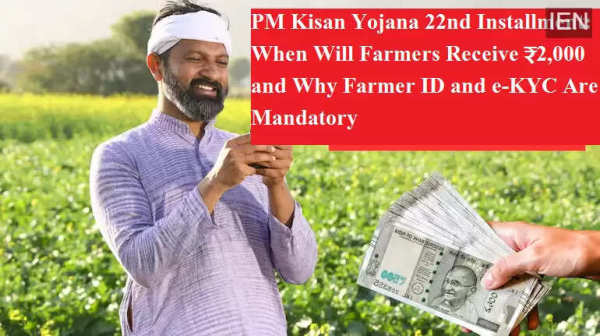
As 2026 begins, millions of farmers across the country are eagerly waiting for the 22nd installment of the Pradhan Mantri Kisan Samman Nidhi (PM-KISAN) scheme. Under this flagship welfare programme, eligible farmers receive financial assistance of ₹2,000 per installment directly into their bank accounts. However, this time the government has made it clear that completing certain formalities is mandatory. Without a valid Farmer ID and e-KYC, the upcoming installment may get delayed or even stopped.
The government has introduced a new requirement for PM-KISAN beneficiaries: a unique Farmer ID. Authorities have clarified that farmers who do not have a Farmer ID will not receive the 22nd installment, even if they have completed e-KYC. This move is aimed at improving transparency, eliminating duplication, and ensuring that benefits reach genuine and eligible farmers only.
The Farmer ID acts as a digital identity for farmers and is linked to Aadhaar as well as land records maintained by the state authorities. Any changes in land ownership or records are automatically updated in the Farmer ID system, reducing paperwork and errors.
Farmer ID is a unique digital identification number created for farmers. It is connected to Aadhaar and integrated with land record databases. This ensures that farmer data remains accurate and up to date.
The biggest advantage of Farmer ID is convenience. With a single verified identity, farmers can easily access multiple government schemes without repeatedly submitting documents. It also helps improve farmers’ access to markets, credit facilities, and subsidy-based programmes, making the overall system more efficient and farmer-friendly.
PM-KISAN is one of the world’s largest Direct Benefit Transfer (DBT) schemes. Launched on February 24, 2019, the scheme aims to provide financial support to all eligible landholding farmer families. The objective is to help farmers meet agricultural and household expenses and ensure income stability.
Under the scheme, eligible farmers receive a total of ₹6,000 every year. This amount is paid in three equal installments of ₹2,000 each, credited directly to the beneficiary’s bank account every four months.
So far, the government has released 21 installments. The most recent, the 21st installment, was transferred on November 19, 2025, by Prime Minister Narendra Modi from Coimbatore.
According to media reports and official indications, the 22nd installment of PM-KISAN may be released between February and March 2026. However, no official date has been announced yet. Farmers are advised to regularly check updates on the official PM-KISAN portal to stay informed about the exact release schedule.
Apart from Farmer ID, completing e-KYC remains compulsory to receive PM-KISAN benefits. The agriculture department has reiterated that installments can be withheld if e-KYC is not completed.
Farmers can complete e-KYC through multiple channels:
The official PM-KISAN website
The PM-KISAN mobile application
Nearest Common Service Centre (CSC) using biometric verification
Completing e-KYC through any of these methods ensures that beneficiary details are verified and payments are processed without issues.
Once the 22nd installment is released, farmers can easily check their payment status online. Follow these steps:
Visit the official PM-KISAN website.
Go to the “Know Your Status” section.
Enter your registration number.
Fill in the captcha code.
Enter the OTP received on your registered mobile number.
After completing these steps, the screen will display complete details related to your installment. If your name appears in the beneficiary list, you will receive the ₹2,000 payment. If not, it is advised to contact the concerned agriculture officer to get your details corrected or updated.
The PM-KISAN scheme continues to be a crucial financial support system for farmers. However, with the introduction of Farmer ID and strict e-KYC requirements, compliance has become more important than ever. Farmers who wish to receive the 22nd installment on time must ensure that both Farmer ID and e-KYC are completed without delay. Staying updated and proactive can help farmers avoid payment disruptions and continue benefiting from this important government scheme.