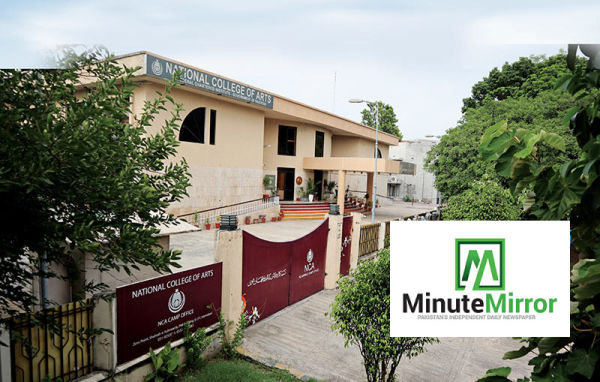
Lahore: The National College of Arts (NCA) Degree Show 2026 opened this week, presenting a compelling reflection of the social, emotional, and political realities shaping Pakistan’s younger generation of artists. Spread across the historic NCA campus, the exhibition moved beyond an academic showcase to become a socially engaged narrative addressing identity, injustice, and survival in a deeply complex society.
At a time when social hypocrisy, gender inequality, and economic uncertainty continue to define everyday life, the Degree Show revealed how contemporary art remains a vital tool for questioning what is often normalized and left unchallenged. Through diverse mediums and conceptual approaches, graduating students highlighted contradictions embedded within cultural, moral, and institutional structures.
Art has historically played a key role in reshaping public consciousness by encouraging societies to re-examine traditions and beliefs once accepted without resistance. In Pakistan, however, contemporary art continues to struggle for broader appreciation. Artists frequently face limited professional recognition and financial instability, despite the high level of training provided by institutions such as NCA. The disconnect between creative excellence and viable career opportunities remains a pressing concern, raising critical questions about the sustainability and purpose of art education today.
Among the many notable practices presented at the exhibition, the works of Yumna, Faatima, and Sheharbano, a graduate of the miniature painting department stood out for their emotional depth and strong social relevance. While visually distinct, their practices collectively addressed invisible pressures created by patriarchy, emotional suppression, and structural inequality, offering a critical response to a society that often claims moral order while enabling exclusion and injustice.
Stitching Silence: Women, Labour, and Social Hypocrisy
Yumna’s work directly confronted the systemic mistreatment of women within a male-dominated social framework. Drawing inspiration from reformist Urdu literature such as Ashraf Ali Thanvi’s Bihishti Zewar, the novels of Deputy Nazir Ahmed, and popular moral narratives including Jannat Kay Pattay, her practice critically examined how ideals of obedience, sacrifice, and moral purity continue to shape expectations of women in contemporary society.
While these texts are widely celebrated for offering moral guidance, Yumna questioned the ways in which they reinforce control and restriction under the guise of virtue. Rather than illustrating the narratives themselves, she responded to them materially by employing thread, a medium historically associated with domestic and feminine labour.
Through textile installations and mixed-media works, Yumna highlighted the emotional, psychological, and physical labour women are expected to perform silently. Repetition, restraint, and endurance were embedded within her surfaces, creating tension that reflected suppressed voices and unacknowledged suffering. The stitched forms became visual metaphors for emotional containment and societal expectation.
In a culture that publicly emphasizes respect and honour while privately enabling inequality, her work exposed deep-rooted social hypocrisy. By making visible the unpaid labour, limited autonomy, and emotional deprivation experienced by women, Yumna’s practice functioned as a form of quiet resistance. Rather than direct confrontation, her work relied on subtlety and material language to deliver a powerful social critique.
Living in Uncertainty: Emotional Weight and Abstraction
Faatima’s paintings approached injustice from a psychological perspective, focusing on emotional states shaped by uncertainty and instability. Her abstract works explored feelings of suspension, inner conflict, and emotional weight, experiences familiar to a generation navigating social pressure and economic precarity.
Dense layers of dark pigment resisted immediate interpretation, mirroring the ways emotions are often suppressed rather than openly expressed. Subtle tonal shifts and recurring horizontal divisions placed viewers within unresolved spaces, suggesting emotional thresholds instead of clear conclusions. Muted blues, blacks, and earthy tones blended into one another, while visible traces of process emphasized time, repetition, and persistence.
In a culture driven by certainty and control, Faatima’s work acknowledged vulnerability as a shared human condition. Her paintings quietly challenged the belief that strength must be defined by clarity or resolution. Instead, they recognized uncertainty as a lived reality particularly for young people facing shrinking creative spaces, rising costs, and limited opportunities.
Through abstraction, Faatima gave form to emotional experiences that often remain unnamed, allowing ambiguity to become a legitimate and meaningful visual language.
Process, Control, and Quiet Resistance in Miniature Painting
Sheharbano’s miniature painting practice added another critical dimension to the exhibition’s broader conversation. Rooted in traditional miniature techniques, her work challenged rigid systems of control that govern both artistic production and social behaviour.
Rather than beginning with a predetermined image, she allowed her paintings to develop intuitively through process. This approach emphasized gradual change, small gestures, and careful attention to detail reflecting lived experiences in a society where progress is often slow and barely visible.
By prioritizing process over outcome, Sheharbano questioned productivity-driven models that dominate both the art world and economic life. Her work subtly resisted authority whether institutional, cultural, or patriarchal by creating space for uncertainty, reflection, and organic growth.
A Collective Reflection
Together, the works at the NCA Degree Show 2026 formed a collective reflection on the realities confronting Pakistan’s youth. Through diverse practices, the exhibition demonstrated how contemporary art continues to function as a critical voice challenging hypocrisy, exposing inequality, and articulating emotional truths often left unheard.
As these emerging artists step beyond the academic space, their work raises important questions about the future of creative practice in Pakistan and the structures needed to support it. The Degree Show ultimately stood as both an artistic achievement and a reminder of art’s enduring role in questioning power, tradition, and silence.
We welcome your contributions! Submit your blogs, opinion pieces, press releases, news story pitches, and news features to opinion@minutemirror.com.pk and minutemirrormail@gmail.com