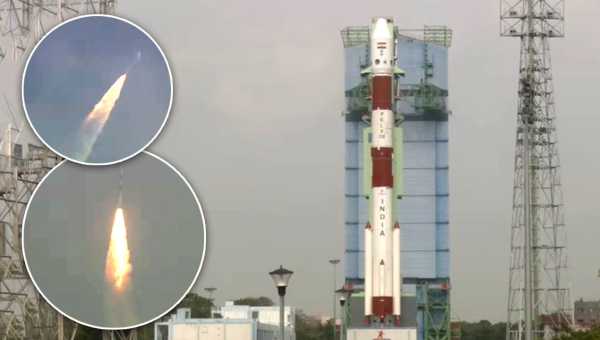
The first satellite mission of the year 2026 was launched by the Indian Space Research Organization (ISRO) today (Monday, January 12) at 10.18 am from the Satish Dhawan Space Center in Sriharikota, Andhra Pradesh. This launch was done from Polar Satellite Launch Vehicle (PSLV)-C 62. However, something went wrong at the last moment. The team is currently investigating this error.
ISRO has also issued a statement regarding the irregularities that have come to light. It has been said that an error occurred at the end of the PS3 stage in the PSLV-C62 mission. Its detailed analysis has been started. In total, 15 satellites were sent into space in the first launch. The most important Earth Observation Satellite (EOS-N1) Anvesha was also included in these.
The PSLV-C62 mission encountered an anomaly during end of the PS3 stage. A detailed analysis has been initiated.
— ISRO (@isro) January 12, 2026
Anwesha was going to be placed in Polar Sun-Synchronous Polar Orbit (SSO) about 600 kilometers above the Earth in the coming time. By doing this, it will be able to easily keep an eye on everything from terrorists to infiltrators and miscreants. Anvesha is being called the CCTV of India. This is because with its help the enemy will now be monitored.
Anvesha Satellite has been developed by Defense Research and Development Organization (DRDO). Even after being above the ground, it can capture photographs of enemies hidden in forests or bunkers. Satellite (EOS-N1) exploration is very important for India. This is because only with its help the enemy will be monitored in the times to come.
It will be installed at an altitude of just 600 kilometers. From here it will keep its sharp eye everywhere. After its installation, enemies will neither be able to build bunkers nor smuggle drugs and weapons. This satellite will help the army a lot.
EOS-N1 is a hyperspectral imaging satellite developed by DRDO. Anvesha Satellite works on 'Hyperspectral Remote Sensing' i.e. HRS technology, which detects more spectrum of light. This will help India to secure its borders. Actually it works like a secret weapon for the armies. Anvesha will pass through the earth's point at a certain time.
Apart from EOS-N1, 15 satellites have been sent into space in the PSLV-C62 mission. These include one main Indian satellite and 14 other small satellites. Out of these 14, 8 are foreign satellites, which are from France, Nepal, Brazil and Britain.