In Hindu religion, there is a tradition of observing the auspicious time before doing any auspicious or good work, on which people have deep faith. Different periods and time periods are observed before starting the auspicious work. One of these times is called Kharmas. Kharmas is the period when Sun God enters Sagittarius or Pisces. It is believed that during this period the speed of the Sun slows down, hence doing auspicious activities like marriage, house warming etc. is considered prohibited. Kharmas comes twice in a year but one of them is given special importance.
According to mythological beliefs, this time is considered best for self-contemplation, chanting, penance and spiritual practice. It is said that during this period the brightness of the Sun decreases, hence it is not considered favorable for new auspicious works.
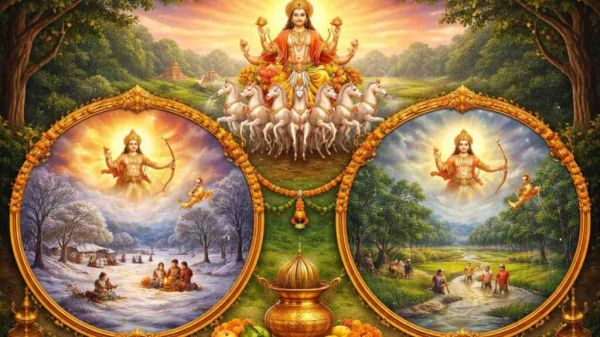
According to mythological belief, when the horses of Surya Dev’s chariot get tired, then they add donkeys (Khar) to the chariot. Due to this, the speed of the chariot slows down and the Sun takes a month to complete its revolution. For this reason this period is called Kharmas. At this time the brightness of the Sun is also considered relatively less.
The main reason for this is to astronomical and astrological beliefs. According to astrology, Jupiter (Guru) has two zodiac signs – Sagittarius and Pisces. When Sun God enters any sign of his Guru Jupiter, he offers a part of his energy and radiance to the Guru. For this reason, the Sun is considered less influential or ‘impure’ at that time.
Since Jupiter has two zodiac signs, the Sun enters Jupiter’s zodiac sign twice in a year and hence Kharmas occurs twice in a year. The first time this happens is when the Sun enters Sagittarius, which is usually in mid-December. The second time the Sun enters Pisces is around mid-March.
Dhanu Kharmas, also known as Winter Kharmas, starts around 14–15 December and lasts till 14–15 January every year. It culminates on Makar Sankranti, when the Sun enters Uttarayan. This period is considered very auspicious for devotion, sadhana and religious activities. This time is the peak of winter. According to astrology, during this time the Sun remains in the position of Dakshinayan, which is considered the last phase of the ‘Night of the Gods’. Therefore, the end of Kharmas and the arrival of Makar Sankranti is celebrated as a festival throughout the country.
Pisces Kharmas is also called Summer Kharmas. It starts around 14–15 March and continues till 13–14 April. It ends on Aries Sankranti, which is also celebrated as Vaisakhi. It is considered similar to Malamas. This is the month of Chaitra, which marks the beginning of the Hindu New Year. During this period, Sun is in Uttarayan and its power starts increasing but due to Jupiter being in Pisces, auspicious works are not done. This is also the period of change of seasons when spring comes to summer.
Dhanu Kharmas is considered more important from the spiritual point of view because after Makar Sankranti, the direction of the Sun changes and the ‘Day of the Gods’ begins. At the same time, after the end of Pisces Kharmas, the Sun enters its ‘exalted’ zodiac sign (Aries), which is considered to be the most powerful time for the beginning of new energy and auspicious works.
Right now Dhanu Kharmas is going on and it will end with Makar Sankranti on 14th January 2026. Only after that all the stalled auspicious and auspicious works will be able to start again.
Note: The things written in this news are based on religious and local beliefs. We do not confirm this.