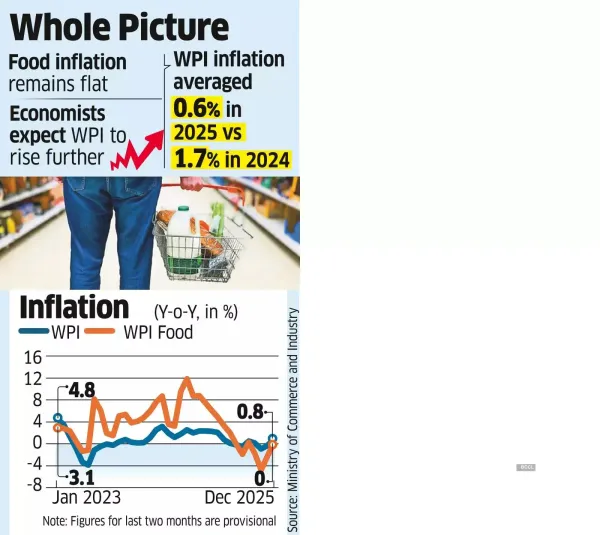
New Delhi: Wholesale prices moved out of deflation after two straight months, recording an eight-month-high inflation of 0.83% in December, official data released Wednesday showed, as food prices stayed flat and manufactured products became costlier.
The Wholesale Price Index (WPI), the key gauge for measuring inflation, fell 0.3% in November. The index rose 2.6% in December 2024.
Retail inflation, meanwhile, accelerated to a three-month high of 1.3% in December from 0.7% in November.
"WPI inflation is once again less than 1%, reflecting both base effects and stable prices," Bank of Baroda chief economist Madan Sabnavis said.
Aastha Gudwani, India chief economist at Barclays, said: "Narrowing deflation in 'food articles' and a rise in inflation in 'manufacturing products' drove the increase in the headline."
On an annual basis, wholesale inflation averaged 0.6% in 2025, lower than 1.7% in 2024.
"Positive rate of inflation in December 2025 is primarily due to increase in prices of other manufacturing, minerals, manufacture of machinery and equipment, manufacture of food products and textiles, etc.," the commerce ministry said in a statement.
Food inflation, which accounts for around one-fourth of the WPI basket, remained flat in December, after prices contracted 2.6% the month before.
"The WPI food inflation is expected to harden further in January 2026 and continue on an upward trajectory thereafter owing to an unfavourable base," said Rahul Agrawal, senior economist at ICRA.
Deflation was recorded in key food items like cereals (1.2%), pulses (13.9%) and vegetables (3.5%). Potato and onion prices declined by 38.2% and 54.4%, respectively.
Manufacturing products, which account for 64.23% of the WPI, recorded 1.8% inflation in December compared with 1.3% in November.
"Manufactured inflation reflects largely GST (rationalisation) impact and will keep it sub-1% in months to come," Sabnavis said.
The Wholesale Price Index (WPI), the key gauge for measuring inflation, fell 0.3% in November. The index rose 2.6% in December 2024.
ET Budget Survey: Tell us your wishlist
Retail inflation, meanwhile, accelerated to a three-month high of 1.3% in December from 0.7% in November.
"WPI inflation is once again less than 1%, reflecting both base effects and stable prices," Bank of Baroda chief economist Madan Sabnavis said.
Aastha Gudwani, India chief economist at Barclays, said: "Narrowing deflation in 'food articles' and a rise in inflation in 'manufacturing products' drove the increase in the headline."
On an annual basis, wholesale inflation averaged 0.6% in 2025, lower than 1.7% in 2024.
"Positive rate of inflation in December 2025 is primarily due to increase in prices of other manufacturing, minerals, manufacture of machinery and equipment, manufacture of food products and textiles, etc.," the commerce ministry said in a statement.
Food inflation, which accounts for around one-fourth of the WPI basket, remained flat in December, after prices contracted 2.6% the month before.
"The WPI food inflation is expected to harden further in January 2026 and continue on an upward trajectory thereafter owing to an unfavourable base," said Rahul Agrawal, senior economist at ICRA.
Food prices stay flat, manufactured goods become costlier
Deflation was recorded in key food items like cereals (1.2%), pulses (13.9%) and vegetables (3.5%). Potato and onion prices declined by 38.2% and 54.4%, respectively.
Manufacturing products, which account for 64.23% of the WPI, recorded 1.8% inflation in December compared with 1.3% in November.
"Manufactured inflation reflects largely GST (rationalisation) impact and will keep it sub-1% in months to come," Sabnavis said.