
Panel to Hear Inter-ministry Disputes, No Courts Involved
New Delhi: Commercial disputes between government entities such as ministries and departments which do not involve a private party will be resolved by inter-ministerial panels from the next financial year, said officials aware of the move.
The parties to the dispute will no longer approach the court, as the central government is replacing the administrative framework to resolve commercial disputes with a tighter, time-bound two-tier system.
The framework, cleared by the cabinet secretariat and shared with ministries and departments earlier this week, is expected to lead to quicker resolution of disputes between government entities including state-run companies and decrease the burden on courts.
However, disputes involving income tax, customs and railways have been kept out of the purview of the new mechanism, according to officials.
In case a dispute is not resolved by the panel constituted for the purpose, the cabinet secretary will take a decision on the matter. This will be final and binding, effectively shutting the door on further appeals.
“Why crowd the courts and drag the matter for months when the dispute can be easily settled within departments?” said a senior official, who did not wish to be identified.
The revamped framework will help reduce delays, save public money from being spent on inter-government litigation and enhance accountability by placing the responsibility squarely on administrative ministries, the official added.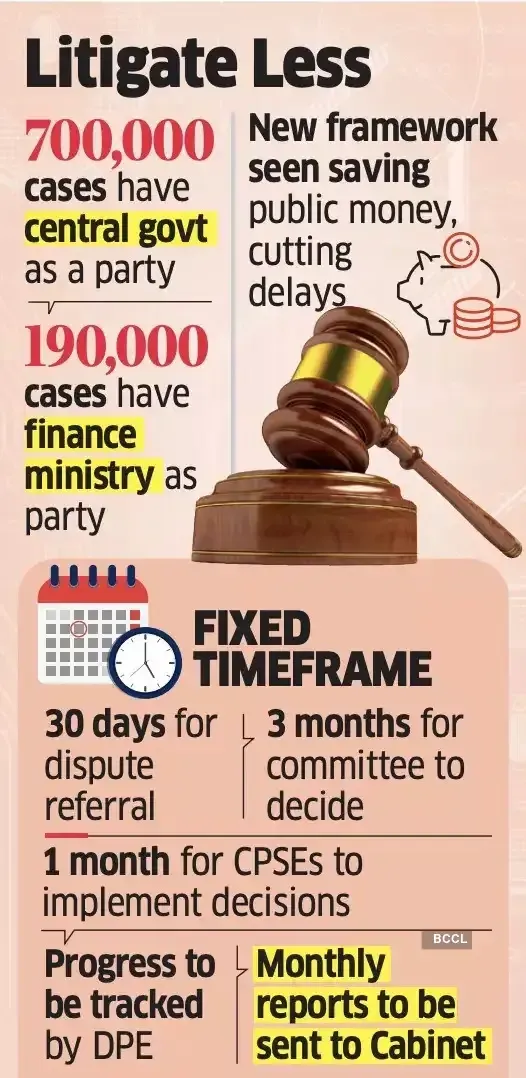
According to a law ministry submission to the Rajya Sabha in February 2025, the central government is party to nearly 700,000 cases pending across courts, with the finance ministry alone being a litigant in nearly 200,000 cases. The framework makes it mandatory for central public sector enterprises (CPSEs) to incorporate the new dispute resolution mechanism in all existing and future contracts with other public sector undertakings and government bodies.
The framework also prescribes stricter timelines.
Ministries are required to refer disputes to the panel within 30 days, the panel will have to decide within three months and the decisions must be implemented within a month. Progress will be tracked on a central online portal, with monthly reports sent to the cabinet. The bodies to which the new framework will be applicable have been asked to withdraw pending cases by March 31 and take the new dispute settlement route for inter-ministerial contracts and disputes.
This follows the office memorandum dated December 8, 2025, issued by the Department of Public Enterprises, which had directed ministries to approach it in case of any dispute.
The memorandum also said that the new draft law would replace all earlier and existing memorandums issued under the Administrative Mechanism for Resolution of CPSE Disputes.
The parties to the dispute will no longer approach the court, as the central government is replacing the administrative framework to resolve commercial disputes with a tighter, time-bound two-tier system.
ET Budget Survey: Tell us your wishlist
The framework, cleared by the cabinet secretariat and shared with ministries and departments earlier this week, is expected to lead to quicker resolution of disputes between government entities including state-run companies and decrease the burden on courts.
However, disputes involving income tax, customs and railways have been kept out of the purview of the new mechanism, according to officials.
In case a dispute is not resolved by the panel constituted for the purpose, the cabinet secretary will take a decision on the matter. This will be final and binding, effectively shutting the door on further appeals.
“Why crowd the courts and drag the matter for months when the dispute can be easily settled within departments?” said a senior official, who did not wish to be identified.
The revamped framework will help reduce delays, save public money from being spent on inter-government litigation and enhance accountability by placing the responsibility squarely on administrative ministries, the official added.
Strict Timelines Mandated
The revamped framework will help reduce delays, save public money from being spent on inter-government litigation and enhance accountability by placing the responsibility squarely on administrative ministries, the official added.According to a law ministry submission to the Rajya Sabha in February 2025, the central government is party to nearly 700,000 cases pending across courts, with the finance ministry alone being a litigant in nearly 200,000 cases. The framework makes it mandatory for central public sector enterprises (CPSEs) to incorporate the new dispute resolution mechanism in all existing and future contracts with other public sector undertakings and government bodies.
The framework also prescribes stricter timelines.
Ministries are required to refer disputes to the panel within 30 days, the panel will have to decide within three months and the decisions must be implemented within a month. Progress will be tracked on a central online portal, with monthly reports sent to the cabinet. The bodies to which the new framework will be applicable have been asked to withdraw pending cases by March 31 and take the new dispute settlement route for inter-ministerial contracts and disputes.
This follows the office memorandum dated December 8, 2025, issued by the Department of Public Enterprises, which had directed ministries to approach it in case of any dispute.
The memorandum also said that the new draft law would replace all earlier and existing memorandums issued under the Administrative Mechanism for Resolution of CPSE Disputes.