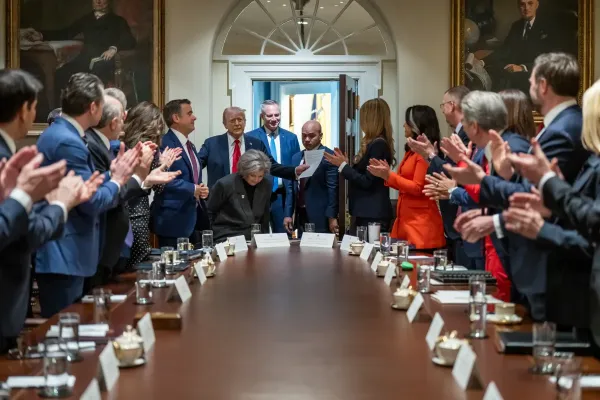
Venezuela–US: The recent meeting between United States President Donald Trump and Venezuelan opposition leader Maria Corina Machado drew global attention, not only because of its political implications but also due to a symbolic act that followed. Machado presented Trump with a Nobel Peace Prize medal, a gesture that sparked intense debate in diplomatic, political, and international affairs circles. While the act carried no official authority under Nobel rules, its timing and symbolism reflected deeper tensions and expectations surrounding Venezuela’s future and Washington’s role in it.
Maria Corina Machado has long been regarded as a central figure in Venezuela’s democratic opposition. For years, she has positioned herself as a leader-in-waiting, representing resistance against the long-standing rule of Nicolas Maduro. Her international visibility increased significantly after she became associated with the Nobel Peace Prize through her advocacy for democratic freedoms and human rights.
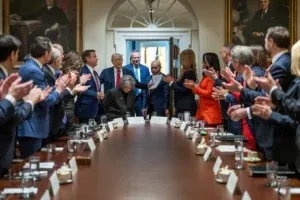
During her visit to Washington, Machado met President Donald Trump at the White House. Following the meeting, Trump publicly praised her and acknowledged receiving what he described as her Nobel Peace Prize medal. According to Trump, the act symbolized mutual respect and recognition of his efforts related to global peace and freedom. He later shared his reaction through his Truth Social platform, describing Machado as a resilient leader who had endured extraordinary hardship.
Despite the strong visual and emotional impact of the gesture, the Nobel Institute clarified that a Nobel Peace Prize cannot be transferred to another individual. The medal presented to Trump therefore holds symbolic value only and does not alter official records. Nevertheless, a White House official confirmed that Trump intends to keep the medal, reinforcing the personal importance he appears to attach to the recognition.
The symbolic nature of the act has not diminished its political weight. Observers noted that it was particularly striking given Trump’s recent political decisions regarding Venezuela, which appeared to sideline Machado in favor of engaging with figures closer to the existing power structure.
After leaving the White House, Machado spoke briefly to reporters, stating that she presented the medal as recognition of Trump’s unique commitment to Venezuelan freedom. Her remarks suggested an attempt to reaffirm trust in US leadership at a time when uncertainty has grown about Washington’s stance on democratic transition in Venezuela.
Trump has previously expressed doubts about Machado’s ability to lead Venezuela, citing what he described as a lack of internal support and respect within the country. These comments followed disputed 2024 elections, which Machado’s party is widely believed to have won but were rejected by the Maduro administration. Trump has also indicated openness to working with acting President Delcy Rodriguez, Maduro’s former deputy, further complicating the opposition’s expectations.
Following the closed-door meeting, Machado emerged near the White House gates, where she was greeted by dozens of supporters. She embraced many of them and briefly addressed the crowd, stating that Venezuelans could count on President Trump. Her words prompted chants of appreciation from some supporters, reflecting hope among segments of the Venezuelan diaspora.
Notably, Machado had maintained a low public profile in the months leading up to her Washington visit. She had spent nearly a year in hiding inside Venezuela before traveling to Norway, where her daughter accepted the Nobel Peace Prize on her behalf. That appearance marked her first major public moment in months and underscored the personal risks she has faced throughout her political struggle.
The episode highlights the fragile and complex relationship between symbolic gestures and real political power. While the presentation of the medal may not change formal diplomatic policy, it serves as a reminder of the expectations placed on global leaders by opposition movements seeking legitimacy and support.
For Venezuela, the future remains uncertain. Questions persist regarding election timelines, international recognition, and the role of external actors in shaping outcomes. For the United States, the event underscores the challenge of balancing strategic interests with public commitments to democracy and human rights.
In the end, the Nobel medal moment may be remembered less for its legality and more for what it revealed about hope, symbolism, and the ongoing struggle for political change in Venezuela.